 |  |
HOW TO HAVE A WILD LUCID DREAM
Set an alarm clock to wake you up after approximately 5 hours of sleep. This is done to wake you in a later REM (Rapid Eye Movement) dream cycle where WILD has been shown to work more often than earlier in the night.
Free Lucid Dreaming eBook
Instant Download, Learn The #1 Habit To Have Lucid Dreams ...freelucidreamingstarterhandbook.com
Tips
- Reminding yourself of your intention before going to sleep will usually get your lucid dreams to occur more often.
- While in a dream you cannot panic or you will be awake again in a sweat. Staying calm is key.
- Immediately after entering the dream it is often useful to not control anything for a short time because it lets your brain enter the dream.
- Rubbing your hands is an effective way to give the dream stability and make it more realistic immediately after entering it.
- Soothing music or releasing tension in muscles before heading to sleep can make your body fall asleep faster, inducing lucid dreams quicker.
- Also try spinning once you are lucid. It will increase your awareness and gain you balance.
Warnings
- Don't drink coffee or soda or anything that will keep you awake before attempting a lucid dream. This should only be used if you can't seem to stay conscious because you are too tired.
Things You'll Need
This Is the front cover photo to Lucid Dreaming by Stephen Laberge  |
|
[From NIGHTLIGHT 1(1), 1989, Copyright, The Lucidity Institute.]
How To Remember Your Dreams
Remembering your dreams is the starting place for learning to have lucid dreams. If you don't recall your dreams, even if you do have a lucid dream, you won't remember it! And, in order to be able to recognize your dreams as dreams while they are happening, you have to be familiar with the way your own dreams work. Before it will be worth your time to work on lucid dream induction methods, you should be able to recall at least one dream every night.
Getting plenty of sleep is the first step to good dream recall. If you are rested it will be easier to focus on your goal of recalling dreams, and you won't mind so much taking the time during the night to record your dreams. Another benefit of getting plenty of sleep is that dream periods get longer and closer together as the night proceeds. The first dream of the night is the shortest, perhaps 10 minutes in length, while after 8 hours of sleep, dream periods can be 45 minutes to an hour long. We all dream every night, about one dream period every 90 minutes. People who say they never dream simply never remember their dreams. You may have more than one dream during a REM (dream) period, separated by short arousals that are most often forgotten. It is generally accepted among sleep researchers that dreams are not recalled unless the sleeper awakens directly from the dream, rather than after going on to other stages of sleep.
It can be useful while you are developing your dream recall to keep a complete dream journal. Keep the journal handy by your bed and record every dream you remember, no matter how fragmentary. Start by writing down all your dreams, not just the complete, coherent, or interesting ones--even if all you remember is a face or a room, write it down.
When you awaken in the night and recall what you were dreaming, record the dream right away. If you don't, in the morning you may find you remember nothing about the dream, and you will certainly have forgotten many interesting details. We seem to have built-in dream erasers in our minds, which make dream experiences more difficult to recall than waking ones. So, whenever you remember a dream, write it down. If you don't feel like writing out a long dream story at 3 AM, note down key points of the plot. Also write down the precise content of any dialogue from the dream, because words will almost inevitably be forgotten in a very short time.
Possibly, all you will need to do to increase your dream recall is to remind yourself as you are falling asleep that you wish to awaken fully from your dreams and remember them. This works in a similar manner to remembering to awaken at a certain time in the morning. Additionally, it may help to tell yourself you will have interesting, meaningful dreams. A major cause of dream forgetting is interference from other thoughts competing for your attention. Therefore, let your first thought upon awakening be, "What was I just dreaming?" Before attempting to write down the dream, go over the dream in your mind, re-telling the dream story to yourself. DO NOT MOVE from the position in which you awaken, and do not think of the day's concerns. Cling to any clues of what you might have been experiencing--moods, feelings, fragments of images, and try to rebuild a story from them. When you recall a scene, try to recall what happened before that, and before that, reliving the dream in reverse. If after a few minutes, all you remember is a mood, describe it in a journal. If you can recall nothing, try imagining a dream you might have had--note your present feelings, list your current concerns to yourself, and ask yourself, "Did I dream about that?" Even if you can't recall anything in bed, events or scenes of the day may remind you of something you dreamed the night before. Be ready to notice this when it happens, and record whatever you remember.
If you find that you sleep too deeply to awaken from your dreams, try setting an alarm clock to wake you at a time when you are likely to be dreaming. Since our REM periods occur at approximately 90 minute intervals, good times will be multiples of 90 minutes after you go to sleep. Aim for the later REM periods by setting the alarm to go off at 4.5, 6, or 7.5 hours after you go to sleep. Once again, when you wake up, don't move and think first of what you were just dreaming before writing.
To remind yourself of your intentions and get yourself into the spirit of your dreams, read through your dream journal at bedtime. Learning to remember your dreams may seem difficult at first, but if you persist, you will almost certainly succeed--and may find yourself remembering four or more dreams per night. Of course, once you reach this level, you probably won't want to write them all down--just the significant or compelling ones. And, the more familiar you become with the style of your own dreams, the easier it will be to remember you are dreaming while you are dreaming--and explore the world of your dreams while still on the scene.
[From NIGHTLIGHT 5(2), Summer 1993, Copyright, The Lucidity Institute.]
TESTING THE LIMITS OF DREAM CONTROL: THE LIGHT AND MIRROR EXPERIMENT by Lynne Levitan and Stephen LaBerge
Lucid dreaming offers the promise of enhanced control over dreams. Yet the question remains quite unanswered of how much dream control is possible. The ability to have lucid dreams also makes possible a way to study this issue. After having attained lucidity in a dream, dreamers can choose to carry out predetermined experiments testing their ability to achieve certain goals. In the "Free Fall" issue of NightLight (Vol. 4, No. 4) we asked lucid dreamers to attempt certain tasks in lucid dreams and to report on the outcome. An introduction to the many viewpoints on dream control will put the findings from this study in context.
WAYS OF CONTROLLING The definition of "control" used here is "the ability to determine or influence the course of events." This means that an individual's actions are causes with subsequent effects. One way to refine this definition is to distinguish between voluntary and involuntary control. Voluntary control means that you decide you want to produce a certain effect and take steps to cause it. For example, you want the house to be cleaner so you throw away stray papers. Involuntary control refers to unintended consequences of your actions. For example, one of those stray papers you threw away was the outline of the presentation you are to give tomorrow. The result is you have to write a new one. In a dream, an example of an involuntary effect would be causing a dream monster to pursue you by running away. There are different ways to approach controlling dreams. A method that does not require lucidity is predetermination: selecting the setting or topic of the dream prior to sleep. This is akin to the idea of "dream incubation" in which a person works to induce a dream about an important topic in order to answer a question or resolve a conflict. In her book, Creative Dreaming, Patricia Garfield presents some evidence that motivated people can choose to dream about desired topics. Post-hypnotic suggestions have also been employed in attempts to elicit particular dream topics, again with some success, as described by Charles Tart in his essay in Conscious Mind, Sleeping Brain, edited by Gackenbach and LaBerge (1988). Success with creating a particular dream setting, however, does not imply the ability to control the sequence of events in the dream. Concurrent control is ability to determine or alter the course of a dream in "real time," as it happens. This type of control is not limited to lucid dreams, anymore than our effect on the waking world is limited to times when we are thinking about what we are doing. Anytime we make a choice or act in a dream, we are controlling it. We may be unconscious of the reason for our choice, but the decision nonetheless originates within the self. However, people possessing lucid consciousness in their dreams are able to make deliberate choices and actions with full knowledge that they are experiencing a dream, and observe their effects on the course of the dream. The question addressed here is how well can we influence dreams in the directions we desire? Do actions produce the aimed-for effects? Do we have more or less control over our experiences in dreaming than in waking?
THE RANGE OF OPINIONS REGARDING DREAM CONTROL In the modern world, a wide variety of theories and opinions about the possibility or impossibility of dream control coexist. At one extreme, stand (or, perhaps, stood, as this viewpoint may have faded in the face of irrefutable evidence) some sleep researchers whose reluctance to believe in the possibility of deliberate dream control came hand in hand with their disbelief in the verity of lucid dreaming. Their opinions rose out of a faulty philosophy defining sleep as "unconsciousness," meaning lack of cognition. A better operational definition of sleep would be, "lack of perceptual awareness of the sleeper's environment." Without consciousness, clearly one could not consciously will anything. So, until an awareness arose among those studying dreams that dreaming was a state of consciousness, not unconsciousness, progress was not possible in this area. Another kind of disbelief has arisen from dreamworkers, who employ dreams to help people achieve better psychological balance. Much of dream-based therapy (although not all) has operated on the premise that dreams are things that happen to people, rather than events that people create. The creator of dreams has been named the "unconscious." Because of this and the prevailing notion in the scientific world that sleep is unconsciousness, it has become common for people to believe that dreams occur in the unconscious mind, independent of the conscious "ego." This cannot be true, however, because if it were, we would not be able to recall the experiences we have in dreams. Events that do not reach consciousness are not accessible to memory. The "I" of the dreamer, the one who sees, hears, feels, and reflects on the events happening in a dream is the self-awareness, the "ego," and it is conscious, although it may not be aware that its present circumstance is an entirely mentally- constructed world not guided by sensory information from physical reality. As an illustration of the point of view that dreams are both from and in the unconscious, here is an excerpt from Working with Dreams by Ullman and Zimmerman: Q. Can we program or control our dreams? A. No, not consciously. If we look upon a dream as a kind of natural resource flowing within us, if we liken it to a river, a river shaped by our life experience, then its flow will not be changed simply by having someone on the shore urge a new direction on it. But if the person on the shore does the work necessary to make a change in direction possible, the flow will alter as desired. The point of the analogy is that there has to be more than conscious intent to influence the flow. There has to be a genuine emotional investment. In the view expressed, dreams are predetermined "plays" somehow programmed out of the individual's current psychological processes. They are nothing like waking life. These same authors make an interesting comment about lucid dreaming. They state: "Although the dreamer can influence the subsequent course of dream once it becomes a lucid dream, the element of control occurs only within certain limits. An analogy might be Living Theater where, after the actors have created a certain framework, the audience is invited to influence the subsequent course of the play." This statement implies that dream control is limited to actions appropriate to the original setting of the dream, which has its own defined boundaries and rules. This seems to imply that whatever part of the mind determines the original dream setting has primacy over other parts of the mind. Certainly, one of the great mysteries of dreams is what determines the original setting and situation one finds oneself in a dream. Despite reports that some people are able to decide what they will dream about on occasion, for the most part, dream topics seem to arise out of some source that is definitely not in consciousness. However, there is no evidence in support of Ullman and Zimmerman's contention that dream control is limited by the framework of the original dream setting, and many would refute it based on their own experience. The Tibetan Buddhists, creators of the Dream Yoga, teach that it is possible to control every aspect of dream imagery. They use dream control as a method of comprehending the illusory nature of all experience, with the ultimate goal of transcending the relative and embracing the Absolute. In the "Doctrine of the Dream State" from Tibetan Yoga and Secret Doctrines translated by Evans-Wentz, we find the following instructions: At the outset, in the process of realizing [the dream] to be maya, abandon all feeling of fear; And, if the dream be of fire, transform the fire into water, the antidote of fire. And if the dream be of minute objects, transform them into large objects; Or if the dream be of large objects, transform them into small objects: Thereby one comprehendeth the nature of dimensions. And if the dream be of a single thing, transform it into many things; Or if the dream be of many things, transform them into a single thing... Then, the editors comment: By such practices, the yogin is taught to realize that matter, or form in its dimensional aspects, large or small, and in its numerical aspects, of plurality and unity, is entirely subject to one's will when the mental powers have been sufficiently developed by the yoga. In other words, the yogin learns by actual experience, resulting from psychic experimentation, that the character of any dream can be changed by transforming or willing that it shall be. A step further and he learns that form, in the dream-state, and all the multitudinous content of dreams, are mere playthings of the mind, and therefore, as unstable as mirage. A further step leads him to the knowledge that the essential nature of form and of all things perceived by the senses in the waking state are equally as unreal as their reflexes in the dream state..." The Tibetan Buddhists, however, were and are not given to sharing their personal dream experiences, so we cannot examine the nature of their dreams and their efforts to control them. Some notable Western expert lucid dreams have given us a look into what they have been able to accomplish. The Marquis d'Hervey de Saint-Denys was an extraordinarily accomplished lucid dream and wrote instructively about his experiences. He exhorted his readers to strive to control their dreams in his 1867 book Dreams and How to Guide Them: Those who would see in the incidents of our dreams merely a succession of mechanically produced impressions over which one has no more control that a simple spectator has over some pictures will naturally declare any effort and any exercise of attention or will to be incompatible with the very nature of dreaming. Since the most valuable observations I have been able to make seem to me to be due to my ability to maintain the faculties of attention and will during sleep, I shall naturally place great emphasis on convincing the reader that he can and should exercise the same control over himself. Here I come to what is perhaps the most interesting of my new propositions, and one that is open to experimentation on any reader's part. For it is through the combined action of attention and will during dreams that one can take the first steps in directing and modifying the course of dreams as one wishes. Perhaps no one has experimented personally with dream control as much as Alan Worsley, the inveterate lucid dreamer who can claim to be the first to signal lucidity with eye movements in a sleep laboratory. First, a comment from Worsley regarding voluntary and involuntary control in dreams: "Non-lucid dreams use many principles that can be used in lucid drams. For instance, it is likely, in a non-lucid dram, that if one believes one looks into a book about a certain subject, one will find relevant pictures in it. In lucid dreaming, one can use this principle by deliberately selecting a book about a subject one wishes to study." Worsley has tabulated his attempts to influence dreams. A complete table of his results appears in Conscious Mind, Sleeping Brain, edited by Gackenbach and LaBerge. He rates the difficulty of various tasks as Hard, Medium, and Difficult, based on the percentage of times he was able to succeed at them. For example, he finds all attempts to penetrate dream matter with his dream body to be easy. Making sounds by striking things or speaking is easy. Reading single words or short phrases is easy, but reading long sentences is hard. He was never able to suddenly turn on a light in a dark room, although he was able to do so easily in a light room. Flying close to the ground was easy, and got progressively more difficult the higher he would try to go.
EXPERIMENTAL STUDY OF DREAM CONTROL The wide range of opinions on the topic of dream control, and the reports we received of people's attempts to control dreams, piqued our curiosity about why it is sometimes it possible to achieve a desired outcome, and sometimes it is not. Because dreams are entirely illusory, it should be possible to experience anything imaginable. Thus, perhaps failures arise from not imagining strongly enough, or not believing a certain experience is possible. On the other hand, perhaps there are physiological limitations on the ability to control dream imagery. Our theoretical approach to dreams is based on the idea that the perceptual experiences in dreams arise out of activity in the same brain areas that produce perceptual experience in waking. This is why people have difficulty distinguishing dreaming from waking experience, and have to employ special techniques to recognize when they are dreaming. Physiological constraints on dream perception might occur if a certain brain area is not in a state conducive to the desired experience. For example, it might be hard to make a dark dream light, because the visual cortex is not active enough. This is one of the topics of research we would very much like to see explored: the relationship between dream perception and brain activity. The NightLight study was designed to assess how successful people would be at accomplishing certain well-defined tasks in lucid dreams.1. LIGHT SWITCH TASKS ------------------------------------------------------------------------ A. Find a light switch (indoors). B. Turn it on, and see what happens, then turn it off, and see what happens. C. Turn the lights on and off by willing it to happen and observe the results. (These two tasks were counterbalanced so that some tried the "magic" first and some second.) 2. MIRROR TASKS ------------------------------------------------------------------------ A. Find a mirror. B. Observe your reflection in the mirror. C. Move your hand to your face, watching it in the mirror and observe how the reflection behaves. D. Pass through the mirror and see what is on the other side. (The instructions gave an example in which the dreamer passes through the mirror and ends up in a different scene.)These tasks represented a variety of types of influence, ranging from things that are easy to accomplish in waking (turning on a light, looking in a mirror), to impossible in waking (passing through a mirror). In addition, some tasks we thought might be impeded by brain state were included (the changing of light level). The purpose of asking people to both will a light on and off and switch it was to see what effect belief might have on the outcome. It is easier to believe a light will turn on when a switch is flipped than that will alone will turn on a light. The instructions asked the participants to try each task in waking prior to attempting the tasks in lucid dreams, so that they would have the procedure well-rehearsed. Then, they were to try each task at least once in a lucid dream. They did not need to complete all the tasks in one dream, but could use as many lucid dreams as they needed. So that they would not forget details, the participants were asked to awakening immediately after the experimental lucid dreams and make complete reports of their experiences.
RESULTS Twenty-seven people submitted reports of their attempts to carry out the assigned tasks, fourteen women and thirteen men. Altogether they provided 65 lucid dream reports, an average of 1.4 per person. The maximum number of reports from one individual was four. A judge reviewed the reports to determine which tasks were attempted in each dream, and scored the result. The scoring for the tasks of finding a light switch or a mirror was either as "success" or "failure." The results of the actions of turning a light switch on and off, willing a light on and off, looking at a reflection, touching hand to face, and passing through a mirror received scores of "expected" if the result achieved the goal, "no result" if the action produced no response, and "unexpected" if something unpredictable happened. "Expected" for turning and willing a light on and off meant that the light went on and off as it would in waking. "No result" meant the light did not change. "Unexpected" meant something other than the chosen light turning on and off. Examples of unexpected light results were: "the bulb slowly filled with what appeared to be thick, black tar," and "When I threw the switch, the outside porch light came on instead of the room light...didn't really increase the overall illumination." For the task of looking at a reflection, a score of "expected" was given when people reported that their reflections in the dream looked like their reflections in waking. "No result" indicated that the person saw no reflection. This happened once; the person instead saw gray, swirling mist. If the reflection looked unlike the waking image, the result was rated "unexpected." The same criteria as for the reflection applied to moving the hand to the face while watching in the mirror. An example of "unexpected" for this task was, "As I raise my hand to my face I see the reflected image of my hand go up but from then on I notice an increasingly 'hallucinogenic' breakdown of the image--such things as my finger, detached from my hand, disappearing into my mouth and holes appearing in my face." The result of trying to pass through a mirror was scored as "expected" if the dreamer was able to move through the mirror and found another setting on the other side. "No result" meant that the dreamer found the mirror hard and unyielding, as in waking. "Unexpected" applied to cases in which the dreamer got through the mirror, but was then somewhere unlike what was described in the task instructions, for instance, in the same room, or "in a world of cartoon-like images." The table [below] shows the results of the participants' tries at the tasks. The left-hand columns list the number of people who attempted each action and the number who achieved each kind of result. The right hand columns display the total number of tries at each task, and the number leading to each result. Looking at the number of "expected" results, that is, cases in which the action produced the desired result, it appears that "willing" a light to turn on or off and using a dream switch are about equally easy. There seemed to be more cases of "no result" with willing the light on, but the difference did not pass a statistical test. The data hint that it may be easier to get a dream light to turn off than on. However, this conclusion may be premature, given that in the majority of cases, before trying to turn off a light, the person had already succeeded in turning it on. There may be a condition in which if you can turn on a light in a dream, you can also turn it off. Clearly, it was very easy to find things in dreams that are usually around in waking, like a light switch and a mirror. People also had no difficulty performing the normal action of looking in a mirror and seeing a reflection, although it was more likely than not somehow different than the usual waking reflection, and in 12 cases (28%) the image transformed as the dreamer watched. This happened for 41 percent of the participants. It would be reasonable to predict that passing through a mirror to another scene would be the most difficult task, given that it is impossible in waking life. However, almost half of those who tried succeeded, and 86 percent of the people were able to get their dream bodies through the dream mirror at least once, even if they did not end up in a new scene. An example of an "expected" mirror result was, "I then went through the mirror and tried to imagine that the mirror was like water so I could easily slide through it. When I was fully through the mirror, I came up to the surface of the water I was in and noticed I was in a bright, sunlit backyard swimming pool with a roof shelter over it."
DREAMS CAN BE DIRECTED, BUT STILL DO THEIR OWN THING The lack of large differences in the ease of accomplishment of the various tasks is in itself quite interesting. Lucid dreamers are able to exert a large amount of control over their dream experiences. But, it is far from perfect. Most notable is the reluctance of the mirror reflections to show normal images, and their fascinating instability. Self-image is of course a very psychologically loaded thing, probably with very complex internal representations. This may account for the strange images. The instability points up the most prominent difference between waking and dreaming perception. Dreams change. We exploit this in lucid dream induction training by instructing people to examine written phrases repeatedly, watching for them to change. An interesting question is whether the perceptual instability results from the lack of anchoring sensory input from the physical senses or from a state of the brain peculiar to REM sleep. In their studies, the Marquis d'Hervey de Saint-Denys and Alan Worsley observed something they called the "light switch" phenomenon. This was an inability to change the illumination of a room on demand. From this study, it seems that this phenomenon is sometimes present and sometimes not. Some people who were able to turn on lights reported no concurrent change in general illumination, but others reported that there was an increase in brightnessÑabout half and half. So, "the light switch phenomenon" is not dead, but merely seems to be sleeping some of the time. A prime target for research would be to discover what the brain is doing under both circumstances. It was rather remarkably easy for people to pass through a mirror and find something else on the other side. One might think, along the lines of the quote earlier from Ullman and Zimmerman, that a complete scene change would be a difficult thing to accomplish. In fact, we have already seen in another study that it is more than possible. In the results from an experiment published in the April 1987 issue of Omni magazine, 51 people reported trying to arrive a particular pre-selected target by spinning in a dream. Eighteen of them (35%) succeeded in arriving at their target. Thus, not only is it possible to create a new scene, but also to create one that is specifically desired. In the final analysis, the Tibetan Buddhist view that all dream images are transmutable may be exactly right. If so, we wonder if it may be possible also to learn to control the stability of these images, creating lasting dream scenes and objects, achieving a state of virtual reality far beyond the wildest dreams of the computer programmers.
TABLE 1. Results of attempts to control dream content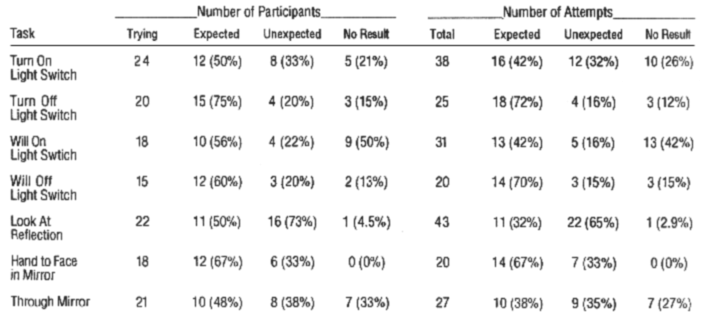
[From NightLight 6(3), 1994, Copyright, The Lucidity Institute.]
An Hour of Wakefulness Before Morning Naps Makes Lucidity More Likely
By Stephen LaBerge, Leslie Phillips, & Lynne Levitan
Morning naps provide us highly favorable circumstances for inducing lucid dreams. Two important factors are at work here: timing and wakefulness during sleep. (The term "nap" indicates that the target sleep period is immediately preceded by a period of wakefulness; "morning" indicates the relevant time-of-day.) A series of NightLight experiments exploring the relationships between napping, length of sleep, continuity of sleep, biological rhythms, and lucid dreaming, have repeatedly demonstrated a strong relationship between taking morning naps and increased likelihood of lucid dreaming. (1, 2, 3, 4)
Working from the premise that lucid dreaming is associated with increased REM propensity and REM intensity, both of which are typically at or near their peak late in the morning, the first of our nap studies, "The Best Time for Lucid Dreaming," (1) compared the following sleep schedules: a. Taking a two-hour nap two hours after getting up two hours early (i.e., taking a nap at the normal waking time) and b. Taking a two-hour nap starting four hours after getting up two hours early (i.e., taking a nap two hours later than the typical rising time) to assess their relative value in promoting lucid dreams. Overall, lucid dreams were 10 times more likely in the naps than the preceding nights. More lucid dreams per total dreams occurred in the two-hour delayed nap than in the four-hour delayed nap (an average of one lucid dream out of each two dreams versus one lucid dream out of each three dreams, respectively). Although the number of subjects in this study was not large enough for the differences between the two napping conditions to be statistically significant, it was very encouraging that these nap schedules showed much more effect on lucid dreaming than any of our previous studies of lucid dream induction by mental exercises.
Our second nap study, "Get Up Early, Take a Nap, Be Lucid," (2) compared three different sleep schedules, one each night. In the first schedule, Condition A, participants awakened 90 minutes before their normal waking time, stayed up for 90 minutes, and did a special MILD exercise for 10 minutes before falling back to sleep for a 90-minute nap. In the second sleep schedule, Condition B, participants also awakened 90 minutes prior to their normal waking time, but then went right back to sleep after doing the MILD exercise for 10 minutes to finish a "normal" night's rest. In the third sleep schedule, Condition C, subjects slept their complete normal sleep time, woke up and did the MILD exercise, then returned to sleep for 90 extra minutes. In Condition A (delayed nap), 8% of participants had lucid dreams in the night, and 67% in the nap; none of the participants had lucid dreams in the night portion of Condition B ("normal" sleep with MILD), and 33% in the nap; 17% of participants had lucid dreams in the night portion of Condition C (prolonged sleep), and 8% in the nap. In other words, Condition A (which included the delayed nap) was, by far, the sleep schedule most conducive to lucid dreaming, with a full two-thirds of participants recording lucid dreams under these circumstances. The results of this study indicated that there was something about the delayed sleep that greatly improved lucid dreaming ability, as the prolonged sleep in Condition C, which happened in the same time of the morning as the Condition A nap, was not associated with these elevated levels of lucidity.
The value of a period of wakefulness in promoting lucid dreaming has been known since the late 70s when LaBerge noted that certain activities "in the middle of the night" have been observed to increase the likelihood of lucid dreaming upon a subsequent return to sleep (3). Patricia Garfield, (4) for example, found that, in her case, "sexual intercourse during the middle of the night was often followed by a lucid dream." Scott Sparrow, in contrast, found that early morning meditation favored lucid dreaming (5). Additional anecdotes cited by LaBerge (3) indicated that early morning reading or writing was also favorable. The diversity of these activities suggested that it is not the particular activity, but the alert wakefulness that facilitates lucid dreaming during subsequent sleep. (3)
Following up on this observation, in our third experiment, "The Best Time for Lucid Dreaming: Naps, Mishaps, and Recaps," (6) we planned to study the effect of varying periods of wakefulness before naps (10 minutes versus 90 minutes), but due to an ambiguity in the instructions, many participants did not start their naps at the same time for the two conditions, confounding the impact of varying periods of a.m. wakefulness with changes in the circadian phase. Also, those who were asleep less time probably had less time in REM and, thus, less opportunity for lucid dreams. Despite these complications, we were able to effectively compare the first and second parts of sleep, which again showed a.m. naps to be much better than nights for lucid dreaming.
The fourth in our series of nap studies, reported in NightLight 4.4 (7), compared lucid dreaming frequencies in morning and afternoon naps. The results were clearly in favor of morning naps. Nine of the eleven participants had more lucid dreams in morning naps. Two had the same number of lucid dreams in each napping condition. None had more lucid dreams in the afternoon than the morning. Time asleep, for both nap conditions, was approximately one hour. There were slightly fewer total dreams recalled from afternoon naps, but the difference was not of statistical significance. Hence, it seems that the different times of day must somehow be responsible for the varying levels of lucidity.
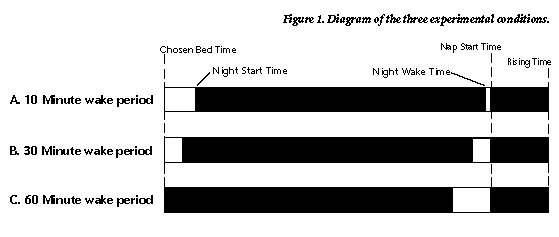
In sum, past nap experiments demonstrate the great impact of morning naps in achieving lucid dreams, but leave questions such as the optimum amounts of sleep and wakefulness prior to the naps largely unanswered. The current study brings us one step closer to determining the ideal conditions for inducing lucid dreams by clarifying the effects of varying periods of wakefulness (10, 30, and 60 minutes) before morning naps.
The Procedure
Participants in the "Wakefulness During the Night: Aiming Towards the Perfect Lucid Dreaming Technique" experiment (8) followed three different sleep schedules, one on each night. In Condition A, they went to bed 50 minutes past their regular bedtime, awoke 10 minutes before their regular rising time, read about lucid dreaming for 10 minutes, then returned to bed for a nap; once back in bed they set their alarm to awaken them in 90 minutes, then practiced a modified MILD exercise for at least 10 minutes or until they fell asleep. In Condition B, they went to bed 30 minutes past their regular bedtime, awoke 30 minutes before their regular rising time, read about lucid dreaming for 30 minutes, then returned to bed for a nap; once back in bed they set their alarm to awaken them in 90 minutes, then practiced a modified MILD exercise for at least 10 minutes or until they fell asleep. In Condition C, participants went to bed at their regular bedtime, awoke 60 minutes before their regular rising time, read about lucid dreaming for 60 minutes, then returned to bed for a nap; once back in bed they set their alarm to awaken them in 90 minutes, then practiced a modified MILD exercise for at least 10 minutes or until they fell asleep. In other words, the three experimental conditions all allowed for the same lengths of time for sleep and napping and held constant the activity to be performed during the period of wakefulness (reading about lucid dreaming), but varied the amount of morning awake time before the naps. This allowed us to assess what impact varying lengths of wakefulness prior to morning naps might have on lucid dreaming.
Results: Stay Awake Longer
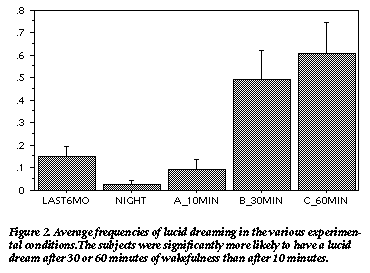
Twenty-two people (12 males and 10 females) submitted acceptable data. (9) Ninety-five percent of them recalled one or more dreams per night. As a measure of their level of skill in achieving lucid dreams we had asked them how many lucid dreams they had recalled within the last six months, and in their best six months of lucid dreaming. Based on the data provided by the group, we would have expected an average of about one lucid dream approximately every seven nights for each participant if they were not involved in the special conditions of this study. Participants averaged one lucid dream every 36 nights during the nighttime portion of this study, and one lucid dream every 11 nights during the Condition A nap. However, dramatically higher rates were found in nap Conditions B and C. On average, participants experienced lucid dreams once every two nights in nap Condition B, and even more (once every 1.6 nights) in nap Condition C.
Participants reported a grand total of 424 dreams during this study--235 (55%) during nights and 189 (46%) during naps. Three of the 235 nighttime dreams (1.3%) were lucid and 50 of the 189 nap dreams (27%) were lucid. In other words, although 55% of the total dreams were reported in the nights, the great majority (94%) of the lucid dreams occurred during naps. Of the 53 lucid dreams, seven were in Condition A (two during nights and five during nap periods following 10 minutes of wakefulness, 20 in Condition B (none during Condition B nights, and 20 in nap periods following 30 minutes of wakefulness), and 26 in Condition C (one in a Condition C night, and by far the highest number of all, 25, during the nap periods following 60 minutes of wakefulness). Nearly half (over 47%) of all lucid dreams from this experiment were reported to have taken place in morning nap periods following 60 minutes of wakefulness. In our current study five times as many participants had lucid dreams in morning naps after 60 minutes of wakefulness compared to naps after only 10 minutes of wakefulness.
Discussion
Holding the other parameters of this study relatively constant allowed us to assess the impact of varying lengths of wakefulness (10, 30, and 60 minutes) on lucid dreaming in a.m. naps. It appears there is something about the increased lengths of wakefulness that somehow better prepares the brain to become lucid in dreams.
Although five lucid dreams were reported in Condition A naps, 20 during Condition B naps, and 25 during Condition C naps, it is significant to note that of five participants in this study who reported lucid dreams in Condition A naps, four actually took at least 15 minutes beyond the minimum 10 minutes of required MILD time (or a total of at least 25 minutes) to fall asleep. Hence, it may be that if these individuals had fallen asleep after only 10 minutes, they may have had even fewer than five lucid dreams during Condition A naps. Also, this may be yet another indication that longer periods of a.m. wakefulness are much more conducive to lucid dreaming.
Note the preceding statement regarding the relationship between increased wakefulness and increased lucid dreaming may have limits not tested in this study. In other words, we would not want to generalize this statement beyond the current findings for the three periods of wakefulness addressed in this study. It could be, for example, that 120 or 180 minutes of wakefulness may be no more effective, or even less effective, than 60 minutes in bringing about the ideal condition for having lucid dreams. This issue will undoubtedly be of interest in future NightLight nap studies.
Conclusion
Getting up an hour early, staying awake for an hour or more reading about lucid dreaming, doing MILD briefly, then taking a morning nap is an excellent means of achieving lucid dreams. This technique is one of the most powerful, promising means of achieving lucidity.
References
(1) Levitan, L. (1990). The Best Time for Lucid Dreaming. NightLight 2(3). (This experiment commenced in NightLight 2(1)).
(2) Levitan, L. (1991). Get Up Early, Take a Nap, Be Lucid. NightLight 3(1). (This experiment commenced in NightLight 2(3)).
(3) LaBerge, S. (1980). Lucid dreaming as a learnable skill: A case study. Perceptual & Motor Skills, 51, 1039-1042.
(4) Garfield, P. (1975). Psychological determinants of the lucid dream state. Sleep Research, 4, 184.
(5) Sparrow, G. S. (1976). Lucid Dreaming: Dawning of the Clear Light. Virginia Beach: A. R. E. Press.
(6) Edelstein, J. & LaBerge, S. (1992). The Best Time for Lucid Dreaming: Naps, Mishaps, and Recaps. NightLight 4(2). (This experiment commenced in NightLight 3(4)).
(7) Levitan, L., LaBerge, S. & Dole, J. (1992). Morning Naps are Better than Afternoon Naps for Lucid Dreaming. NightLight 4(4). (This experiment commenced in NightLight 4(2)).
(8) LaBerge, S. (1994). Wakefulness During the Night: Aiming Towards the Perfect Lucid Dreaming Technique. NightLight 6(1).
(9) Twenty-eight people submitted data for this experiment. Six data sets were incomplete (typically missing lucid dream reports) or inconsistent, so results from 22 participants were used in this Research Update.
[From NightLight 5(3), Fall 1993, Copyright, The Lucidity Institute.]
Lucidity Research, Past And Future
By Stephen LaBerge, Ph.D
There is a state of consciousness in which any human being could experience anything imaginable. Each of us holds within us infinite possibilities. How many of us ever have the opportunity to taste even a hint of them? If we speak of our fantasies of wider vistas of life, we talk of our "dreams." In our dreams, we are free. A man in a dungeon can dream he is a king in a castle, and while he dreams, it is so.
People have long viewed dreams as blessings or curses beyond our control. However, according to Tibetan Buddhists, who for a thousand years have been practicing a form of dream yoga, similar to what in the west is called lucid dreaming, it is possible to gain complete mastery over dreaming. Recent scientific research at Stanford University has begun to provide objective evidence for that claim.
As is well known to NightLight readers, lucid dreaming means dreaming while knowing that you are dreaming. Everyone has, in theory, the capacity to learn to dream lucidly, because everyone dreams every night. Whenever we dream, we find ourselves in complete worlds, as richly detailed, moving and impressive as the world of waking life. This ability to create worlds is the natural endowment of the human mind. In dreams, this wondrous talent is fully demonstrated. The worlds we create in our minds are so convincingly real we cannot easily tell them from the "real" world of waking.
Lucid dreamers develop a frame of mind that allows them to recognize when they are dreaming. From that point, they are free to do as they choose. This freedom, hard to imagine in our highly constrained waking reality, is astonishing, exhilarating, and inspiring. The laws of physics and society are repealed. The limits are only those of the dreamer's imagination.
Who would not want such a genie at their command? Today, lucid dreaming is a reality, currently being enjoyed and explored by thousands of people. However, for it to achieve its potential of expanding the horizons of all humanity, research advances are necessary. Current training in lucid dreaming takes more time and effort than most people are able to commit. Technology exists to assist people in attaining the state, but although it can greatly enhance a person's chances of having a lucid dream, cannot yet guarantee it.
Research into the factors of brain and mind that underlie the lucid dream state could lead to breakthroughs allowing an individual to lucid dream at will, thereby having reliable access to any imaginable experience. This is much more than a remote possibility. Much is already known about REM sleep, the sleep state in which lucid dreaming occurs, and progress has been made in determining how brain activity changes when a person becomes lucid in a dream. Resources are needed for initiating intensive research into the precise nature of the lucid dream state, and the factors of brain, body and mind involved in achieving and sustaining it.
A convenient and reliable means of entering lucid dreams will open the door to a vast treasury of valuable applications. In worlds of unlimited possibility, creativity will become the rule, rather than the exception. People will be able to sample any way of being they wish, living out fantasies unavailable in waking life, or rehearsing for successful futures.
Experimentation in lucid dreaming is completely risk-free, so ideas in business, politics, ecology, athletics, or indeed, any endeavor can be tested in the model world of dreams. Practice in lucid dreams can improve performance, and prevent costly errors in waking reality. The potentials of mental imagery and hypnosis will also be accessible to everyone, because dreams are the most vivid of all images, available even to those who do not have the ability to create vivid mental imagery or to enter deep hypnotic states while they are awake. This brings with it the possibility of enhanced healing capacities, hinted at in research on mental imagery. People may be able to use lucid dreaming to shorten the time it takes them to recover from illnesses or operations, and to stimulate the redevelopment of physical skills following injury.
All that is required to bring these possibilities to fruition is the devotion of research effort into the area of lucid dreaming. The more resources are supplied to this work, the more rapidly progress will occur, and the sooner this priceless tool will be available to help humanity overcome its present crises. It is abundantly clear that we are in need of quickly developing our capacities for understanding our role on Earth and creatively evolving to survive and grow into our true potential. Lucid dreaming offers great promise for helping us to achieve these goals.
With my colleagues (notably, Lynne Levitan and William Dement), I have been researching lucid dreaming at Stanford University for over a decade. I founded the Lucidity Institute to advance research on lucid dreaming and potentials of human consciousness, and to apply the results of this research to the enhancement of human health and well-being.
The Lucidity Institute has advanced towards the goal of making lucid dreaming universally accessible by developing commercially available lucid dream induction devices such as the DreamLight and DreamLink that help people have lucid dreams.
We are continuing research at Stanford aimed at enhancing the ability to have lucid dreams, and tapping the great potentials within them. Those wishing to contribute to the advancement of research on lucid dreaming please consider the following:
* A tax deductible donation to Stanford University, directed specifically "for research on lucid dreaming under Dr. Stephen LaBerge."
* A loan or investment in the Lucidity Institute, Inc. (Currently the Lucidity Institute Private Placement Memorandum is offering $600,000 worth of stock. Approximately $200,000 has been sold already, leaving $400,000 available.) The Lucidity Institute will provide long-term research funding.
The general aim of our ongoing program of research is the investigation of consciousness and mind-body relationships during sleep. Our primary focus has been lucid dreaming , a state of consciousness with remarkable potential. During lucid dreams, people can reason and remember clearly, and act volitionally upon reflection, while remaining sound asleep and continuing to dream vividly (1).
Lucid dreaming makes possible a new paradigm for dream research. Because lucid dreamers can carry out specific dream experiments, control their dreams and communicate with the laboratory while still asleep (2), scientists can now study the dream state directly. We have pioneered the laboratory study of lucid dreaming (1,2,3) at the Stanford University Sleep Research Center, and thus are well positioned to employ lucid dreaming in the study of the nature of human consciousness and to explore the applications of lucid dreaming in health improvement.
INDUCTION OF LUCID DREAMS
Although we have shown that lucid dreaming is a learnable skill (8), currently available methods, involving mental concentration, require considerable investment of time and effort. Therefore, we have sought methods for helping dreamers to realize that they are dreaming by means of external cues applied during REM sleep that become incorporated into dreams and remind dreamers that they are dreaming. We have tested a variety of stimuli, including tape recordings of the phrase "This is a dream" (9), conditioned tactile stimuli (10), and light (11). Light appears to be an excellent stimulus. We have developed computerized lucid dreaming induction devices (the DreamLight, DreamLink, and most recently, the NovaDreamer) that have produced highly promising results. By further developing and perfecting these and new devices and techniques, we hope to make lucid dreaming widely available.
Lucidity cue type and mental preparation: Preliminary studies on the DreamLight device have been promising: 55% of 44 subjects had at least one lucid dream during one study (11). Unpublished research indicates that combinations of the light cue with mental exercises specifically designed to increase one's awareness of the nature of dreaming tend to be more effective than using the cue alone. At this point we do not know what rate of flashing will be most effective. Therefore we plan to compare four different flash rates (1, 2, 4, and 8 flashes per sec) and three different kinds of mental preparation (MILD, discrimination training to recognize the light stimulus, and post-hypnotic suggestion) in a group of 40 subjects. We also are planning testing cues in other sensory modalities such as sound and vibration.
Physiological correlates of dream content and incorporation of stimuli: Four channels of EEG and four channels of autonomic physiology is being collected from each of 12 to 24 subjects as they are stimulated with flashes of light during REM sleep. Reports of incorporation of light as well as other dream content will then be correlated with the EEG and other physiological measures. Sometimes the subjects will see the light flash in their dreams, but sometimes they will not. Using a computer, we will analyze the EEG and autonomic physiology immediately prior to the time that the stimulus is triggered, looking for differences between the cases when the light is incorporated, and when it is not. By showing us which are the optimal times for applying cues to the dreamer, this research should teach us how to more effectively induce lucid dreams with light.
MIND-BODY RELATIONSHIPS DURING DREAMING
Our work with lucid dreams so far has led to new insights into the connection between mind and body. In a series of studies (summarized below) we have discovered that various dreamed experiences (including time estimation, breathing, singing, counting, and sexual activity) produce effects on the dreamer's brain (and to a lesser extent, body) remarkably similar to the physiological effects that are produced by actual experiences of the corresponding events while awake.
Correspondence between dreamed and actual eye movements We have found that there is a very high degree of correlation between the direction of gaze shift reported in lucid dreams and polygraphically recorded eye movements, a fact that we make routine use of by using eye movements as signals in all of our experiments (1,2).
Communication from lucid dreams We are also planning to improve the capacity of lucid dreamers to communicate with the waking world while dreaming. At this point, they do so by means of eye-movement signals, which are difficult to execute with any complexity. In past studies we have done some preliminary work with a glove containing computerized movement sensors allowing the recording of hand movements during dreaming. The devices were too crude at that point to permit us to see the fine detail needed for distinguishing various hand signals. Current devices are much more sophisticated. We hope to make it possible for lucid dreamers to communicate by means of hand gestures (e.g., American Sign Language) so that we can have on-the-scene reports from the dream world. A glove with movement sensors will be used to study communication from lucid dreams by means of hand gestures, using five expert subjects.
Dream time How long do dreams last? We have been able to receive a direct answer to this age-old question by asking lucid dreamers to estimate various intervals of time while dreaming. The dreamers marked the beginning and end of estimated dream time intervals with eye movement signals, allowing comparison of subjective "dream time" with objective time. In each case, the intervals of time estimated during the lucid dreams were very close in length to the actual elapsed time (1), as shown in the figure below.
![[DREAM TIME IMAGE]](http://www.lucidity.com/gif/time.gif)
Time estimates during waking and REM lucid dreaming. [EEG: electroencephalogram, ROC, LOC electro-oculogram from right and left eye; EMG chin electromyogram.] While awake (top panel), the subject signaled with eye movements, estimated 10 s by counting, signaled again, estimated 10 s without counting, and signaled a third time. The lower panel shows the subject carrying out the same task in lucid REM sleep. The time estimates are very similar in both states.
Control of respiration during lucid dreaming We recorded the physiology of three lucid dreamers who had been asked to either breathe rapidly or to hold their breath in their lucid dreams, marking the interval of altered respiration with eye movement signals. They reported successfully carrying out the agreed-upon tasks a total of nine times. In each case, a judge was able to correctly predict from the physiological records which of the two breathing patterns had been executed (4). We are currently collecting more data to further determine the precise nature of the dream respiration connection.
Brain function lateralization during lucid dreams Alpha activity was derived from right and left temporal EEG while four subjects sang and counted in their lucid dreams. The results indicated task dependent lateralization: the right hemisphere was more activated than the left during singing; during counting the reverse was true. These shifts were similar to those during waking singing and counting (5).
Physiological responses to sex in lucid dreams A pilot study with two lucid dreamers (one male and one female) who reported experiencing sexual arousal and orgasm in lucid dreams revealed patterns of physiological activity during dream sex closely resembling those accompanying corresponding experiences in the waking state (6).
These studies indicate that the effects of dream events on the brain and body are much more like the effects of real events than like those produced by waking imagery (1). Because dream activities produce real physiological effects, lucid dreaming may be useful for facilitating health and healing, as an extremely potent form of mental imagery. We plan to continue our explorations of awareness in dreams along these lines with the goal of producing a detailed map of mind-body interactions during dreaming sleep for all measurable physiological systems. Such a map could prove to be of inestimable value for experimental dream psychology, as well as for psychosomatic medicine.
EEG mapping of lucid dreaming In past studies, we have determined that lucid dreams are generally initiated during periods of high autonomic nervous system activity--decreased finger pulse amplitude, increased respiration rate and irregularity, and increased eye-movement activity relative to normal REM sleep (12). These factors indicated that dream lucidity occurs during periods of relatively high brain activation, suggesting that sufficient activation of the CNS is necessary before consciousness can be attained. However, we had little idea what was specifically happening in the brain, whether the activation was general, or localized in some particular areas.
In a pilot study we mapped the distribution of brainwave activity from twenty-eight electrode placements on the scalp, examining different frequency bands of EEG during periods pre and post-onset of lucidity in five lucid dreams from one subject. The most interesting findings in this preliminary analysis were in the alpha band (8-12 Hz), where decreases of alpha activity were seen in the posterior left hemisphere, in the first 30 seconds of lucidity. This finding is in keeping with an earlier analysis we performed on a few of our lucid dreams at Stanford of left/right ratios of alpha activity, finding the only difference at lucidity onset to be a decrease of alpha activity in the left parietal region. Decreased alpha activity is generally considered an indication of increased brain activation. Indeed, lucid dreaming ought to be associated with left hemisphere activation, (where language is localized), since to become lucid one must actually spell out to oneself, "This is a dream."
We plan to add to and check our findings by collecting more data from more subjects. This will give us a larger sample of non-lucid REM for comparison and show what EEG differences are consistent for all lucid dreams. Thus, we will gain a basis for the comparison of lucid dreaming with other states of consciousness. Twenty-eight channels of EEG will be collected, and maps of EEG activity will be computed, allowing the determination of which brain regions are involved in lucid dreaming (and perhaps reflective consciousness in general). Five expert lucid dreamers will be studied.
APPLICATIONS OF LUCID DREAMING
In addition to being a powerful research tool in scientific explorations of the dream state, lucid dreaming also offers considerable potential for a variety of practical applications, which include aiding personal- development, enhancing self-confidence, overcoming nightmares, improving mental (and perhaps, physical) health, facilitating creative problem solving, and more (1,7). There is a great deal of public interest in this area; we have received well over 10,000 letters from people around the world wishing to know more about lucid dreaming. For this reason, and because we believe lucid dreaming can benefit humanity, we feel that we have a service to perform in making the lucid dream state more readily accessible.
We would like to explore several potential applications of lucid dreaming. One is the use of lucid dreaming in overcoming nightmares. We have anecdotal evidence suggesting that lucid dreaming should be extremely beneficial to nightmare sufferers, giving them the means to overcome their own fears (1). Not only will they be able to alleviate their nightmare problems, but in so doing they will be able to increase their self-confidence and self-esteem. Lucid dreaming can be a very empowering experience, which is one of the reasons we would like to make it more readily available to people. An experimental self-help group for nightmare sufferers will be started and the efficacy of lucid dreaming to overcome nightmares will be studied and documented.
Lucid dreaming could provide the handicapped and other disadvantaged people with the nearest thing to fulfilling their impossible dreams: paralytics could walk again in their dreams, to say nothing of dancing and flying, and even experience emotionally satisfying erotic fantasies. Such sensorimotor practice could conceivably facilitate recovery from stroke.
Finally, lucid dreaming can function as a "world simulator." Just as a flight simulator allows people to learn to fly in a safe environment, lucid dreaming could allow people to learn to live in any imaginable world; to experience and better choose among various possible futures.
RESEARCH GOALS
Our goals are to further explore mind-body relationships and the expansion of consciousness during sleep through lucid dreaming. Specifically, we plan:
A. To make lucid dreaming more accessible by further investigations with biofeedback devices like the DreamLight
B. To study physiological correlates of dream content and of the incorporation of stimuli into dreams
C. To map the EEG correlates associated with the emergence of consciousness during lucid dreaming
D. To explore applications of lucid dreaming
REFERENCES
(1) LaBerge, S. (1985). Lucid dreaming. Ballantine, New York.
(2) LaBerge, S., Nagel, L., Dement, W. & Zarcone, V. (1981a). Lucid dreaming verified by volitional communication during REM sleep. Perceptual and Motor Skills, 52, 727-732.
(3) LaBerge, S. (1981). Lucid dreaming: Directing the action as it happens. Psychology Today, 15, 48-57.
(4) LaBerge, S., & Dement., W. (1982a). Voluntary control of respiration during REM sleep. Sleep Research, 11, 107.
(5) LaBerge, S., & Dement, W. (1982b). Lateralization of alpha activity for dreamed singing and counting during REM sleep. Psychophysiology, 19, 331-332.
(6) LaBerge, S., Greenleaf, W., & Kedzierski, B. (1983). Physiological responses to dreamed sexual activity during lucid REM sleep. Psychophysiology, 20, 454-455.
(7) Gackenbach, J. & LaBerge, S. (Eds.), (1988). Conscious Mind, sleeping brain: Perspectives on lucid dreaming. New York: Plenum.
(8) LaBerge, S. (1980). Lucid dreaming as a learnable skill: A case study. Perceptual and Motor Skills, 51, 1039-1042.
(9) LaBerge, S., Owens, J., Nagel, L., & Dement, W. (1981b). 'This is a dream': Induction of lucid dreams by verbal suggestion during REM sleep. Sleep Research, 10, 150.
(10) Rich, R. (1985). Lucid dream induction by tactile stimulation during REM sleep. Unpublished Honors Thesis, Department of Psychology, Stanford University.
(11) LaBerge, S., Levitan, L., Rich, R., & Dement, W. (1988). Induction of lucid dreaming by light stimulation during REM sleep. Sleep Research, 17, 104.
(12) LaBerge, S., Levitan, L., & Dement, W. (1986). Lucid dreaming: Physiological correlates of consciousness during REM sleep. Journal of Mind and Behavior, 7, 251-258.
[From NIGHTLIGHT 6(2), Summer, 1994. Copyright, The Lucidity Institute.]
A Fool's Guide to Lucid Dreaming
By Lynne Levitan
PEOPLE often want us to specify the criteria for lucid dreaming, asking, "Was this a lucid dream?" and describing some definite non-rationality in the midst of a lucid dream. Webster's definition of lucidity is: "clearness of thought or style," and "a presumed capacity to perceive the truth directly and instantaneously." However, the lucidity referred to in the term "lucid dreaming" as coined by Frederik van Eeden in 1913, refers only to perception of the truth that one is dreaming. This is much like the usage of the word "lucid" in psychiatry to describe a patient who is well oriented to time, person and place.
Knowing that you are dreaming, however, does not automatically guarantee full rationality. Then again, being awake doesn't ensure good thinking, either. Nonetheless, we get more comic relief out of the errors we make in dreams, even lucid ones, than the ones we make while awake. Why do we do stupid things in dreams? One of the possible reasons is that we are less familiar with dreams and how they work, because most of the time in them we assume we are awake and so miss out on many opportunities to learn the ropes. Another possibility is that the dreaming brain is actually less intelligent than the waking brain, at least sometimes. Perhaps there is something about the activity of the brain in REM sleep that, on occasion, makes the dreamer's actions seem like those of a brain-damaged person.
The "brain damage" theory is plausible, given that the electrical activity of the brain varies tremendously in REM sleep, from less to more than in waking. Maybe our inner experiences change along with that activity, ranging from dull and irrational, to ecstatic and sharp-witted. On the other hand, the majority of mistakes made in lucid dreams are probably the result of "dream naivete," that is, a lack of understanding of what is and is not appropriate to the time and place of the dream world. Until you have accumulated sufficient experience at testing the boundaries of dream reality, and overcoming inhibitions from waking life, then you are likely to misinterpret situations and overlook chances to try something new.
One way to look at rationality in dreams is to classify different levels of lucidity. At the highest level, the dreamer would not only be aware of dreaming, but also possess complete understanding of the implications of this knowledge, and would behave in accordance with that understanding on all levels from thought to action. The lowest, minimal level of lucidity would be realization of dreaming, but without understanding how dreaming is different from waking, and without acting on the lucidity at all, mistaking events, characters and consequences with those from waking life. Yet, degrees of rationality vary from moment to moment in dreams, so that one wishing to use a scale of levels of lucidity would have to rate each decision, action, or response of the dreamer independently. Averaging the lucidity levels in a dream might be a way of establishing a lucidity "score" for the dream. All of this is for future research to decide.
As a start on approaching this issue, I picked 38 instances of irrational thoughts and actions from lucid dreams. Half came from my own dreams (so no one should feel I'm picking on them), and half from the lucid dreams submitted for the "Minds & Machines" experiment written up in this issue's Research Update. I have classified them into categories of different types of errors. Three categories covered most of the examples.
1. Being Afraid of "Physical Harm"
There are certain kinds of situations in which action is reflexive, not awaiting decisions from the conscious mind. Fearful circumstances are one example. It is much better for our skins, in general, if we respond quickly to danger, in a way that will increase our chances of avoiding harm, usually running away, less often fighting. Consciousness can override behavioral impulses resulting from fear, but is unlikely to do so without good reason, decided on in advance. For example, some people decide that, for the pleasure of skydiving, they will ignore the terror involved in jumping from an airplane 10,000 feet above the ground.
I go into the closet and throw myself out the window. Briefly, I doubt if I'm dreaming, again, and get stuck halfway through the screen. Wow, what if I weren't dreaming, I think; I'd be killing myself!
I became aware that I was lucid and started to change my size and quasi flying with the Jeep. When I noticed the other cars I became worried and pulled over for concern of safety. I lost lucidity...
I want to go into the house, so I fly up to a window on the second story and try to fly through. I bump into the screen. I tell myself that I should be able to get through. I'm banging against the screen with my hand and scraping myself up a little. I'm not entirely lucid because I think even though I'm dreaming it's probably not wise to get cut up like that.
...I reflect on the lucidity itself as being so effortlessly stable that I don't even have to try or struggle to maintain it....I am in a cafeteria type place and remember my intention to look for lottery numbers...[looks for lottery numbers]...I ask if there are any Lotto 6/49 machines around am told there is one--at a nearby tourist centre on the edge of the [military] compound. I go there and find myself walking down a slightly wooded lane. There are some men doing something that looks covert. I hesitate, then proceed and seeing others around am reassured....The next example illustrates how lucidity can help negate irrational fear:
Spinning is easy. I see a chart of words--which seem to be possible dream selections. I choose the one that says, "Joy Traveler" and don't remember any others. I come to a scene in my parents' living room with Fred standing next to me. The light is dim blue. Fred has no shirt on, is tan, with golden highlights in his hair and no hair on his chest--he looks good. I go outside with him, to the front yard. I say, "Fred, you never have lucid dreams. Indeed, you rarely remember your dreams." He agrees. As we're crossing the street, Fred ahead of me, I see a car at the corner backing up. I tell Fred to watch out; this car is backing up towards him. We fly up into a tree and hold on. The car drives back at us (going forwards now), so I figure it really was trying to hit us. I tell Fred to fly higher into the tree. I realize I am feeling some fear and it's of this car. I decide I should deal with it rather than going somewhere else. I yell to Fred, "Merge!" and as we dive at the car, I hear him making a grunt of surprise and shock. The car comes up slowly. A flap opens in the top and shoots projectiles out. Then a stereotypical terrorist with a gun leans out the back. I note all this and keep falling at the car. When I hit: "POOF" and the scene vanishes. I see notes on paper float before me and think, these are of no interest to me and I feel myself wake up.
2. Being Afraid of "Social Consequences"
Social interactions are another case in which behaviors are automatic. As children, we learn how to behave in a variety of social circumstances, the difference between public and private, and the consequences of breaking the rules. Parents discipline their children to train them to act "correctly," and peers punish with ridicule, exclusion and violence when a child does something "forbidden," such as urinating or crying in public. As we mature, we internalize this training to make it unconscious, because even a momentary slip-up can cause severe social consequences. Once social rules become unconscious, only deliberate conscious decisions can override them.
The people populating our dreams are only mental images of people, with no power over our social standing in waking life, yet they look and act completely real. It can be extremely difficult to ignore the dictates of our social training when faced with wholly realistic "people." The following analogy might make the challenge understandable in a waking context: Imagine you are in a room with a window into another. It is a one-way window that allows you to see into the other room, where a group of people is sitting, looking in your direction as if watching you. However, they cannot see you, because their side of the window is mirrored. How would you feel about undressing, using the toilet, picking your nose, having sex, or, say, singing, in such a situation? Now imagine that the "audience," although they cannot see you and do not know what you are doing, have shocked or amused expressions on their faces as you carry on with your embarrassing activity. Dream characters are mental images of people that we endow with the social reactions we have learned to expect from others. Thus, if you decide to take your clothes off in a dream, the dream people around you might act astonished, because that is what you would expect in waking life. Your knowledge that there are no actual people there is purely intellectual, contradicted by the evidence of your senses, which see and hear a social situation and automatically define for you appropriate and unacceptable behaviors. It takes solid lucidity and a strong will, at least initially, to overcome the internalized mental constraints of society in the essentially private world of dreams.
Wandering about again, I see some money on a table--a big stack, with a $1 bill on top. A minute later, it's a smaller stack with a $20 bill on top. I pocket it. Around this time the light flashes (DreamLight) and I reflect that it doesn't matter what I do 'cause it's a dream. But it doesn't sink in yet, and I'm a bit worried about being caught.
I find myself saying over and over, "This could be a dream," and say, "This is a dream." But I continue with the story because I'm very emotionally involved in it. I'm with B, approaching the place where M is going. B says something about B being with M and me and M replies with something about taking off as many clothes as we can when we get there. I wonder at this lack of discretion.
I'm in a foreign country staying at a hotel and I know there's a nice French girl in the reception area. I know I'm dreaming and I'm in a hurry to meet her before I wake up. I run through the building.... I find the girl and decide to go back to my room.[Risks losing the girl to the instability of dreaming, probably because of a lack of awareness that there is no need to go to a private room for sex in a dream.]
Then the old woman says it's 21 something. Then she thanks me, and gives me some ... money, towards something. She doesn't look as though she can afford it so I don't take it at first, but then accept it so as not to hurt her.
3. Thinking Another Dream Character is "Really" There
One research aim in child psychology is to identify when children recognize that other people are like themselves in having emotions, needs, pain, pleasure, etc. Before that time, presumably, we treat ourselves as the center of the universe, and everything else as being important only in how it affects our well being. Once awareness of self and other dawns, our choices generally reflect concern for others, although the degree of consideration we show others varies greatly. Fear of social consequences reinforces our social deference, which in common parlance we usually call "goodness." Being "bad" is being selfish or cruel, that is, not considering the feelings of others. Another way of describing this aspect of human psychology is to say that we learn at some age that other people are "real," like us, and to treat them accordingly. And so we do in our dreams, too. Of course, as long as we think dream characters are "really there," we are likely to be concerned about social consequences, as described above.
I believe that B is also dreaming and aware and thus we are having a "mutual dream."
Inside with M, we decide we're both dreaming and attempt simultaneous signals. I can't understand some of what he says, then he mutates to look like some food by Chef-Boy-Ar-Dee.
I see an arm coming from behind a tree, and tell myself, "That's him." So, sure enough, when I get there, it is S. He is wearing a belt with an amazingly shiny buckle in some angular pattern--this startles me a bit. We embrace and kiss--this is sort of insubstantial. Now he wearing shiny silver mylar pants, and looks like a slick cowboy. I am not too clear about it being only my dream. I have a few thoughts like--he'll remember this, too. He is very sharp and clear and startlingly real. I ask him to come with me and we'll fly. He doesn't believe it will work. I know it is me who is causing him to be uncooperative. I tell him it always works with my dream characters. I take his hands to pull him up.
I run down the hall into the kitchen, deciding on my way that I will do a back flip in mid air when I get there. I do it smoothly and land on my feet. ...I am full of energy but I don't know what to do next. I say that I want to do something little. At some point I eagerly suggest to M "Let's go wake up your sleeping body!" I mention something about flying through people. M says, "You can't fly through me unless you are some alien who can get up my nose." I begin to think something like "I don't think anyone can fly through you (if you're real) not even aliens" but fear saying it before "one appears and proves me wrong." I tell M that I've flown through dream people before and if they were real it must have been an offensive act. (This seemed logical at the time; that the dream people could be real.) If they were real then I am sorry that I flew through them.
As the bad guys get out of the truck, we fly into the air. I call to my dog, and he flies up to me, and we fly and fly. It's all so easy and I'm very relaxed. Knowing that I'm dreaming, I try to think of other interesting dream places I've been to so that I can show them to my sister. I lucidly fly out of the dangerous dreams I remember and take her to some fun places.
I know I'm dreaming as I fly about with R and others. I encourage R to try to remember this experience [not lucid enough to realize I'm talking with a dream character]. We hover in front of a striking glass picture of pale green hues, with flower designs embossed into its surface. I tell R that lucid dreams are even more easy to recall than non-lucids.
I was walking in a building. I was going to meet with some people. My plan was to meet in a dream with people I was going to meet in waking tomorrow. Then, I would compare the waking meeting with the dream meeting. (I don't know from where this idea came. I never considered this experiment.)... I lost lucidity.
Steve and I and Sasha and Shane are doing laundry downstairs in Ethel's basement, where there are dozens of washers and dryers stacked against the wall. Sasha takes the grocery cart I've hung our clothes on because she wants to use it to hold the helium tank for blowing up balloons. I blow up a few balloons, Sasha and her friends blow up a few balloons, but they keep popping for some unknown reason. I start wondering what's happening with the balloons and notice a boy using the tank on a single balloon which gets larger and larger until it's the size of small hot air balloon. He finally pulls the balloon away from the helium tank and I remember thinking that the balloon was so huge it would carry him away. The next thing I know, Steve and I are looking up at the sky and there's a white parachute coming down--as it gets closer, I can see two people on the chute--one has skis on and is doing flips. I'm wondering aloud to Steve how this is possible and explicitly say, "This must be a dream--we're dreaming--this is a lucid dream! We're both in the same lucid dream." I waited for Steve to come to the realization that he was dreaming (i.e. the logic was that we're in the same dream because we each put ourselves there, not because I, the dreamer, had constructed this experience). I wanted Steve to write down that this was a dream so we'd remember.
In the meantime, I'm still watching the two boys with the parachute come in for a landing. They landed off behind trees in a distance in a mountain of popcorn, which exploded when they landed. I again say to myself and to Steve that this is a dream--I remark on how stable the environment is--I find it hard to believe. We're in a beautiful lush canyon area--lots of blue-greens and purples, water below--we stop to watch the ocean and a surfer who seems to grow out of a wave. I remember the environment as exceptionally vivid and detailed and satisfying. I "check back" to see if I'm still dreaming--determine that I am, and say to my husband that I'm going to fly a little more as long as I'm lucid. The environment switches to the Southwest and the colors change to mauves, sandstones, etc.
...a creature that looks like a deformed elephant seal comes toward shore. Some guys are trying to capture it. My son and I are watching, spellbound. From behind the creature comes a giant octopus, at least ten feet in diameter. We back away from the water's edge, but it comes right out of the water and at us. It is purple and I can see the lighter colored suctions on the underside of it's raised tentacles. We are trying to back up into a tree. Due to the intense emotion, I become lucid. I tell my son, "Relax, we're dreaming and octopi don't climb trees." Now, more aware, I know my son isn't dreaming with me....[As the level of lucidity changes in a dream, it is possible to correct an error of thinking a dream character is real.]
I decide to fly and go straight up toward the roof of the warehouse. There's something hanging there; I think it's a representation of a human, art work of some kind. I say, "Are you the teacher?" Then it's a little girl of four or five who's flown up with me but is suddenly scared to fly down. I hold her in my arms and bring her back to safety. I want to make sure she gets home safely and ask her where she lives. She doesn't answer at first and I think she may be confused and overwhelmed. Then she says, "San Jose." "San Jose!" I repeat, wondering how in hell I'm going to get her back there.The last example above of a lucid dreamer treating a dream character as a real person, in this case, a frightened child, raises an interesting question. If dream characters are based on our expectations, experiences, and biases about people, then our interactions with them can help us illuminate the blueprint we use in approaching others, and possibly even our models of our selves. Therefore, it may not always be the best idea to dismiss dream characters as figments of the dreamer's imagination. They may be valuable representations of facets of your mind. If so, then dream figures are still not "real people," in the sense that they will affect your social situation in waking life, and so do not require adherence to social dictates, but an attitude of respect and curiosity may help you to discover how you see people and your relationships with them. Once again, the advice is to utilize consciousness to choose the most effective approach.
Several other types of flawed thinking appeared in the lucid dreams reviewed. Some of them may be examples of "functional brain damage" in the REM-sleep state. For example, there were some cases of irrational thought, like believing a firewood log is a god in disguise, or thinking that the dreamer's body is acting out the dream actions. In one case, the dreamer could not add beyond 200, and there were several instances of incorrect recall of waking life conditions (sleeping place and whether something really exists). Yet, the majority of errors fit the description of following unconscious patterns set up early in life to protect our lives and social status. Perhaps this exposé of habits inappropriate to dream life can serve as a guide to oneironauts as they stretch their mind-wings into new realms of experience.
[From NightLight 7(3-4), 1995. Copyright, The Lucidity Institute.]
Prolonging Lucid Dreams
By Stephen LaBerge
People frequently awaken from lucid dreams sooner than they would like. Nothing is more frustrating than to invest hours or weeks of effort aiming at the goal of having a lucid dream, and then to wake up within seconds of becoming lucid. Fortunately, however, there are several effective techniques that allow beginners and experts alike to prevent premature awakenings from lucid dreams.
The earliest method for stabilizing lucid dreams was described by Harold von Moers-Messmer in 1938. Moers-Messmer, a German physician, was one of the handful of researchers who personally investigated lucid dreaming in the first half of the 20th century. He was the first to propose the technique of looking at the ground in order to stabilize the dream. [1]
The idea of focusing on something in the dream in order to prevent awakening has independently occurred to several other lucid dreamers. One of these is G. Scott Sparrow, a clinical psychologist and author of the classic personal account, Lucid Dreaming: Dawning Of The Clear Light. [2] Sparrow discusses Carlos Castaneda's famous technique [3] of looking at his hands while dreaming to induce and stabilize lucid dreams and argues that the dreamer's body provides one of the most unchanging elements in the dream, which can help to stabilize the dreamer's otherwise feeble identity in the face of a rapidly changing dream. However, as he points out, the body isn't the only relatively stable reference point in the dream: another is the ground beneath the dreamer's feet. Sparrow uses this idea in this example of one of his own lucid dreams:
"...I walk on down the street. It is night; and as I look up at the sky I am astounded by the clarity of the stars. They seem so close. At this point I become lucid. The dream 'shakes' momentarily. Immediately I look down at the ground and concentrate on solidifying the image and remaining in the dreamscape. Then I realize that if I turn my attention to the pole star above my head, the dream image will further stabilize itself. I do this; until gradually the clarity of the stars returns in its fullness." [4]
A problem with using vision to stabilize a lucid dream is the fact that when a dream ends, the visual sense fades first. Other senses may persist longer, with touch being among the last to go. The first sign that a lucid dream is about to end is usually a loss of color and realism in visual imagery. The dream may lose visual detail and begin to take on a cartoon-like or washed-out appearance. This may all happen very fast; within a few seconds, the dream can fade to black, leaving nothing visual to focus on! For this reason, one might speculate that focus on sensory modalities other than vision may be more useful to stabilize dreams. As it turns out, one would be right.
Dream Spinning
In December, 1978 I had the good fortune to discover a highly effective technique to prevent awakenings and produce new lucid dream scenes. I started by reasoning (mistakenly but as it happens, felix culpa!) that since dream actions have corresponding physical effects, relaxing my dream body might inhibit awakening by lowering muscle tension in my physical body. The next time I was dreaming lucidly, I tested the idea. As the dream began to fade, I relaxed completely, dropping to the dream floor. However, contrary to my intention, I seemed to awaken. But, a few minutes later became clear that I had actually only dreamed of awakening. I repeated the experiment many times and the effect was consistent--I would remain in the dream state by dreaming of waking up. However, my experiences suggested that the essential element was not the attempted relaxation but the sensation of movement. In subsequent lucid dreams, I tested a variety of dream movements and found both falling backward and spinning in the dream to be especially effective in producing lucid dreams of awakening (and, of course, thereby preventing premature awakening).
Out of the one hundred lucid dreams in the last six months of the record in my doctoral dissertation, I used the spinning technique in forty percent. New dream scenes resulted in eighty-five percent of these cases. Lucid consciousness persisted in ninety-seven percent of the new dreams. For comparison, during the six months before I developed the technique, in over a third of my lucid dreams I woke almost immediately after becoming lucid and certainly most ended before I was ready.
In the summer, 1989 issue of NightLight we first attempted to determine the general effectiveness of spinning in stabilizing lucid dreams. The results derived from this study were promising, but unfortunately, statistically inconclusive due to too few subjects completing the experiment. There was a trend for lucid dreams to last longer following spinning compared with a control condition.
As an aside, it is worth noting that while in my experience with the spinning technique, the new dream scene almost always closely resembled my bedroom, this was not the case for others. For instance, one lucid dreamer found herself arriving at a dream scene other than her bedroom in five out of the eleven times she used the spinning technique. These results suggest that spinning could be used to produce transitions to any dream scene the lucid dreamer expects. In my own case, it appears that my almost exclusive production of bedroom dreams may be an accident of the circumstances in which I discovered the technique.
How Does Spinning Work?
Why should dream spinning decrease the likelihood of awakening? Several factors are probably involved. One of these may be neurophysiological. Information about head and body movement, monitored by the vestibular system of the inner ear (which helps you to keep your balance), is closely integrated with visual information by the brain to produce an optimally stable picture of the world. Because of this integration of information, the world doesn't appear to move whenever you move your head, even though the image of the world on your retina moves.
Since the sensations of movement during dream spinning are as vivid as those during actual physical movements, it is likely that the same brain systems are activated to a similar degree in both cases. An intriguing possibility is that the spinning technique, by stimulating the system of the brain that integrates vestibular activity detected in the middle ear, facilitates the activity of the nearby components of the REM- sleep system. Neuroscientists have obtained evidence of the involvement of the vestibular system in the production of the rapid-eye-movement bursts in REM sleep. [5]
Another possible reason why spinning may help postpone awakening comes from the fact that when you imagine perceiving something with one sense, your sensitivity to external stimulation of that sense decreases. Moreover, and this is probably the most important factor, if the brain is fully engaged in producing the vivid, internally generated sensory experience of spinning, it will be more difficult for it to construct a contradictory sensation (i.e., lying motionless in bed) based on external sensory input. When presented with two contradictory interpretations of the state of our body or the world, our consciousness chooses one or the other, but not both models.
If this is the major reason why spinning helps to prevent awakening, one can readily think of other techniques that should work with similar effectiveness. For example, if you rub your dream hands together as the dream is fading, as long as you are experiencing the sensation of rubbing hands, you cannot experience the contradictory lack of sensation that you would need to feel to wake up and perceive the actual condition of your hands. The experiment in NightLight 7.1 was designed to test this idea and to collect additional evidence on the effectiveness of the spinning technique.
The Experiment
Lucidity Institute members were invited to compare each of the following three "techniques for prolonging lucid dreams." (In fact, one technique--"going with the flow"--was intended as a control.)
A. Spinning When in a lucid dream and the dream began to fade, while they still felt their dream body, they were to spin around like a top, as rapidly as possible. Beginning in a vertical or standing position, they were to turn around on a point with their arms outstretched. It was indicated that it is important to experience a vivid sense of movement. They were to continue to spin until they were in a vivid dream scene, or awake. They were instructed to repeat to themselves over and over while spinning, "The next scene will be a dream."
B. Going with the Flow When subjects were in a lucid dream and the dream began to fade, they were to persist in doing whatever they were doing in the dream before it started to fade, ignoring the fact that the dream was fading. Also, they were to repeat to themselves while carrying on with their dream activity, "The next scene will be a dream."
C. Rubbing Hands Together When subjects were in a lucid dream and the dream began to fade, while they still felt their dream body, they were to vigorously rub their (dream) hands together. They were informed it was important to experience a vivid sense of movement and friction. Participants were to continue to rub their hands until they found themselves in a vivid dream scene, or awaken completely. Also, they were to repeat to themselves over and over while rubbing their hands, "The next scene will be a dream."
Subjects were instructed to try the above three techniques once each, in an order determined by the first letter of their last name.
Several times each day, until their next lucid dream, subjects were to rehearse the technique they were to try next. While awake and pretending they were in a dream, they were to follow the instructions for the technique. Subjects were to repeat to themselves during the practice, as they would in the dream, "The next scene will be a dream." Next, they were to follow the instructions for the respective technique:
* SPINNING: Imagine you are in a lucid dream and it is fading. Then actually spin around, as you will in the dream.
* GOING WITH THE FLOW: Imagine you are in a lucid dream and it is fading. Then continue to do what you are already doing while remaining aware that you are dreaming.
* RUBBING YOUR HANDS: Imagine you are in a lucid dream and it is fading. Then vigorously rub your hands together, as you will in the dream.
In their next lucid dream, subjects were to do whatever they wanted to do, but as soon as they noticed the dream fading, attempt the technique they were scheduled to test. They were cautioned not to wait until they were already awake, and to be sure to persist with the technique until either they were in a vivid dream or completely awake. When they believed they had awakened, they were not to move, and to continue doing the technique in their mind for about 60 seconds. This step was recommended because some people have reported returning to the dream state after having fully awakened if they persisted with practicing the technique in their imaginations. If at this point, subjects felt as though actually awake, they were to be sure to use a reality test to check carefully to make sure they were not still dreaming, to prevent false awakenings.
When subjects actually awoke, they were to estimate how much time passed (in seconds) from when they started the dream-prolonging technique until they awakened or lost lucidity. Then, they were to immediately answer the questions on the Report Form about their experience and to write out complete reports of the lucid dreams.
Subjects also filled out a short questionnaire on their dream recall and lucid dreaming ability which they sent in with the rest of their reports after they completed all three conditions of the experiment.
Results
Thirty-four subjects turned in data. However, not all subjects were able to try all three conditions. Eighty percent tried rubbing, 68% spinning, and 65% going with the flow. Some subjects failed to turn in lucid dream reports or otherwise failed to follow instructions. Only eighteen subjects (53%) tried all three conditions of the experiment correctly.
The lucid dream reports were scored by two independent judges. For each report, judges evaluated whether or not the dream appeared to be prolonged following the spin, flow, or rub technique. If a subject had done more than one technique, the two or three reports were ranked according to the judge's estimate of the relative effectiveness of the different techniques for each subject. Reports which the two judges scored differently were scored by a third judge, using a majority rule to resolve discrepancies.
Both the spinning and rubbing techniques were significantly more likely to be judged as successful in prolonging the dream compared with the going with the flow (control) technique. The same was true of the rank ordering analysis. Only 33% of the flow technique lucid dreams were prolonged, compared with 90% of the rubbing and 96% of the spinning lucid dreams.
The following report illustrates a dream judged to have been successfully prolonged by spinning:
... at that point, the oddness of this super-calculator prompted me to say aloud, "I think this is a dream!" And so it was. However the calculator started to fade and de-materialize, and as it did, so did the dream environment. Immediately I remembered to do the spinning-top experiment.As everything around me turned to blackness--no visual content whatsoever--I started to spin round and say, "The next scene will be a dream" ... I was astonished to find a hole of brightness opening up... the bright hole literally appeared as a break in the black clouds around me, as if the sun were breaking through. I could see the branches of a tree through the hole. As I continued spinning (and it's strange that even though I was spinning round, my sight of the hole was unbroken), I seemed to pull myself towards and through the hole into the countryside of the next lucid dream scene...
The following is an example of a dream judged to have been successfully prolonged by hand rubbing:
I am walking through a beautiful forest. Suddenly I realize I am dreaming. I guess the excitement begins to wake me, so I remember its time for the rubbing hands experiment. I drop a towel I hadn't realized I was carrying, and began to vigorously rub my hands together. I feel my hands rubbing together, experiencing warmth from the friction... My dream stabilizes! I am so happy, I decide to keep walking and explore my beautiful dream forest...
Overall, the odds in favor of continuing the lucid dream were about 22 to 1 after spinning, 13 to 1 after rubbing, and 1 to 2 after going with the flow. That makes the relative odds favoring spinning over going with the flow 48 to 1, and for rubbing over going with the flow, 27 to 1.
Discussion
The results of this experiment seem very clear: both the spinning and rubbing techniques are effective means of prolonging lucid dreams. The fact that the rubbing technique worked as well as it was predicted to supports the theory behind the prediction: that interaction and sensory experience in the dream inconsistent with perception of the state of the body in bed will suppress awakening.
Although the spinning technique was somewhat more effective (relative odds 1.8 to 1 favoring spinning over rubbing) than the rubbing technique, the difference in effectiveness was not statistically significant with this relatively small sample size. Matters for future research to decide are whether spinning has any of the special effectiveness beyond what is explained by the sensory inconsistency theory and if so, whether it is explained by the vestibular stimulation theory.
If there is in fact no difference in effectiveness between spinning and rubbing, rubbing does possess a practical advantage: spinning itself tends to destabilize the visual components of the dream, while rubbing does not. On the other hand, if one is using the technique to change dream scenes, that "disadvantage" becomes an advantage.
Notes
[1] H. von Moers-Messmer, "Traume mit der gleichzeitigen Erkenntnis des Traumzustandes," Archiv Fuer Psychologie 102 (1938): 291-318.
[2] G. S. Sparrow, Lucid Dreaming, Dawning of the Clear Light (Virginia Beach: A.R.E. Press, 1976).
[3] C. Castaneda, Journey To Ixtlan (New York: Simon & Schuster,1972).
[4] Sparrow, op. cit., 43.
[5] A. Hobson, The Dreaming Brain (New York: Basic Books, 1988).
THIS COMES FROM STEPHEN LABERGE'S BOOK
EXPLORING THE WORLD
OF LUCID DREAMING
[From: S. LaBerge & H. Rheingold, (1990). EXPLORING THE WORLD OF LUCID DREAMING. New York: Ballantine. ISBN 0-345-37410-X] ============================================================= CHAPTER 6: PRINCIPLES AND PRACTICE OF LUCID DREAMING ============================================================= HOW TO STAY ASLEEP OR WAKE UP AT WILL So far you have learned how to increase your dream recall and various techniques for inducing lucid dreams. Perhaps you have succeeded in having a few lucid dreams, or perhaps you know how to induce them more-or-less at will. Now that you are learning to realize when you are dreaming, what can you do with this knowledge? As discussed previously, one of the most fascinating potentials offered by lucid dreaming is the ability to voluntary control dreaming. It may be possible to dream anything you choose, as the Tibetan dream yogis believe. But before you can try it, you need to be able to reamain asleep and retain lucidity! Novice lucid dreamers often wake up the moment they become lucid. They can recognize lucidity clues, apply state tests, and conclude that they are dreaming, but are frustrated because they wake up or fall into nonlucid sleep soon after achieving lucidity. However, this obstacle is only temporary. With experience, you can develop the capacity to stay in the dream longer. As you will see in a moment, there are also specific techniques that appear to help prevent premature awakening. If you continue to apply will and attention to your practice you should be able to refine your lucid dreaming skills. PREVENTING PREMATURE AWAKENING Informally experimenting in their beds at home, lucid dreamers have discovered various ways of remaining in the dream state when threatened by early awakening. All the techniques involve some form of dream action which is carried out as soon as the visual part of the dream begins to fade. Linda Magallon, editor and publisher of the Dream Network Bulletin, and an intrepid explorer of lucid dreams, has described how she prevents herself from waking up by concentrating on the senses other than vision, such as hearing and touch. She reports that all of the following activities have successfully prevented awakenings from visually faded dreams: listening to voices, music, or her breathing; beginning or continuing a conversation; rubbing or opening her (dream) eyes; touching her dream hands and face; touching objects such as a pair of glasses, a hair brush, or the edge of mirror; being touched; and flying. [1] These activities all have something in common with the Spinning Technique described below. They are based on the idea of loading the perceptual system so it cannot change its focus from the dream world to the waking world. As long as you are actively and perceptually engaged with the dream world, you are less likely to make the transition to the waking state. Magallon may be a dreamer with an unusually active REM system; it may be that she has little trouble staying asleep once she is in REM. However, many others are light sleepers who find it difficult to remain in lucid dreams for long periods of time. These people need more powerful techniques to help them stay in their lucid dreams. Harold von Moers-Messmer, a German physician, was one of the handful of researchers who personally investigated lucid dreaming in the first half of the 20th century. He was the first to propose the technique of looking at the ground in order to stabilize the dream. [2] The idea of focusing on something in the dream in order to prevent awakening has independently occurred to several other lucid dreamers. One of these is G. Scott Sparrow, a clinical psychologist and author of the classic personal account, LUCID DREAMING: DAWNING OF THE CLEAR LIGHT. [3] Sparrow discusses Carlos Castaneda's famous technique of looking at his hands while dreaming to induce and stabilize lucid dreams. [4] Sparrow argues that the dreamer's body provides one of the most unchanging elements in the dream, which can help to stabilize the dreamer's otherwise feeble identity in the face of a rapidly changing dream. However, as he points out, the body isn't the only relatively stable reference point in the dream: another is the ground beneath the dreamer's feet. Sparrow uses this idea in this example of one of his own lucid dreams: "...I walk on down the street. It is night; and as I look up at the sky I am astounded by the clarity of the stars. They seem so close. At this point I become lucid. The dream 'shakes' momentarily. Immediately I look down at the ground and concentrate on solidifying the image and remaining in the dreamscape. Then I realize that if I turn my attention to the pole star above my head, the dream image will further stabilize itself. I do this; until gradually the clarity of the stars returns in its fullness." [5] DREAM SPINNING Some years ago I had the good fortune to discover a highly effective technique to prevent awakenings and produce new lucid dream scenes. I started by reasoning that since dream actions have corresponding physical effects, relaxing my dream body might inhibit awakening by lowering muscle tension in my physical body. The next time I was dreaming lucidly, I tested the idea. As the dream began to fade, I relaxed completely, dropping to the dream floor. However, contrary to my intention, I seemed to awaken. But, a few minutes later I discovered I had actually only dreamed of awakening. I repeated the experiment many times and the effect was consistent--I would remain in the dream state by dreaming of waking up. However, my experiences suggested that the essential element was not the attempted relaxation but the sensation of movement. In subsequent lucid dreams, I tested a variety of dream movements and found both falling backward and spinning in the dream to be especially effective in producing lucid dreams of awakening. Here is a method for spinning to remain in the dream state: ============================================================= THE SPINNING TECHNIQUE 1. Notice when the dream begins to fade When a dream ends, the visual sense fades first. Other senses may persist longer, with touch being among the last to go. The first sign that a lucid dream is about to end is usually a loss of color and realism in your visual imagery. The dream may lose visual detail and begin to take on a cartoon-like or washed-out appearance. You may find the light growing very dim, or your vision becoming progressively weaker. 2. Spin as soon as the dream begins to fade As soon as the visual imagery of your lucid dream begins to fade, quickly, before the feel of your dream body evaporates, stretch out your arms and spin like a top (with your dream body, of course). It doesn't matter whether you pirouette, or spin like a top, dervish, child, or bottle, as long as you vividly feel your dream body in motion. This is not the same as imagining you are spinning; for the technique to work, you must feel the vivid sensation of spinning. 3. While spinning, remind yourself that the next thing you see will probably be a dream Continue to spin, constantly reminding yourself that the next thing you see, touch or hear will very probably be a dream. 4. Test your state wherever you seem to arrive Continue spinning until you find yourself in a stable world. You will either still be dreaming or have awakened. Therefore, carefully and critically test which state you are in (see Chapter 3). COMMENTARY If I think I have awakened, I always check the time on the digital clock beside my bed. This usually provides a foolproof reality test. Frequently, the spinning procedure generates a new dream scene, which may represent the bedroom you are sleeping in, or some more unusual place. Sometimes the just-faded dream scene is regenerated in all its vivid glory. By repeatedly reminding yourself that you're dreaming during the spinning transition, you can continue to be lucid in the new dream scene. Without this special effort of attention, you will usually mistake the new dream for an actual awakening--in spite of manifest absurdities of dream content! A typical false awakening would occur if, while spinning, you felt your hands hit the bed and you thought: "Well, I must be awake, since my hand just hit the bed. I guess spinning didn't work this time." What you should think, of course, is "Since the spinning hand that hit the bed is a dream hand, it must have hit a dream bed. Therefore, I'm still dreaming!" Don't fail to critically check your state after using the Spinning Technique. ------------------------------------------------------------- EFFECTIVENESS OF SPINNING This method is extremely effective for many dreamers, including myself. Out of the one hundred lucid dreams in the last six months of the record in my doctoral dissertation, I used this technique in forty percent of my lucid dreams. New dream scenes resulted in eighty-five percent of these cases. Lucid consciousness persisted in ninety-seven percent of the new dreams. When spinning led to another dream, the new dream scene almost always closely resembled my bedroom. The experiences of other lucid dreamers who have employed this method have been very similar to mine, but suggest that the post-spin lucid dream need not be a bedroom scene. One of these lucid dreamers, for instance, found herself arriving at a dream scene other than her bedroom in five out of the eleven times she used the spinning technique. These results suggest that spinning could be used to produce transitions to any dream scene the lucid dreamer expects. (See Exercise: Spinning a new dream scene, later in this chapter) In my own case, it appears that my almost exclusive production of bedroom dreams may be an accident of the circumstances in which I discovered the technique. I have tried, with very little success, to produce transitions to other dream scenes with this method. Although I definitely intended to arrive elsewhere than my dream bedroom, I cannot say that I fully expected to. I believe I will someday be able to unlearn this accidental association (if that is what it is). Meanwhile, I'm impressed by the power of expectation to determine what happens in my lucid dreams. HOW DOES SPINNING WORK? Why should dream spinning decrease the likelihood of awakening? Several factors are probably involved. One of these may be neurophysiological. Information about head and body movement, monitored by the vestibular system of the inner ear (which helps you to keep your balance), is closely integrated with visual information by the brain to produce an optimally stable picture of the world. Because of this integration of information, the world doesn't appear to move whenever you move your head, even though the image of the world on your retina moves. Since the sensations of movement during dream spinning are as vivid as those during actual physical movements, it is likely that the same brain systems are activated to a similar degree in both cases. An intriguing possibility is that the spinning technique, by stimulating the system of the brain that integrates vestibular activity detected in the middle ear, facilitates the activity of the nearby components of the REM- sleep system. Neuroscientists have obtained indirect evidence of the involvement of the vestibular system in the production of the rapid-eye-movement bursts in REM sleep. [6] Another possible reason why spinning may help postpone awakening comes from the fact that when you imagine perceiving something with one sense, your sensitivity to external stimulation of that sense decreases. Thus, if the brain is fully engaged in producing the vivid, internally generated sensory experience of spinning, it will be more difficult for it to construct a contradictory sensation based on external sensory input. WHAT TO DO IF YOU DO AWAKEN PREMATURELY Even if you find that despite your best efforts to stay asleep you still wake up, all is not lost. Play dead. If you remain perfectly motionless upon waking from a lucid (or non- lucid) dream, and deeply relax your body, there is a good chance that REM sleep will reassert itself and you will have an opportunity to consciously enter a lucid dream, as described in Chapter 4. For some people with a strong tendency to REM sleep, this happens almost every time they awaken from a dream until they decide to move. Alan Worsley is one of the world's most experienced lucid dreamers. He has been conducting personal lucid dream experiments since the age of five. During the 1970s, he was the first person to signal from a lucid dream in pioneering experiments carried out in collaboration with Keith Hearne. [7] Worsley appears to possess this felicitous sort of physiology, and offers the following advice for dreamers who have just awakened but yearn to return to their lucid dreams: "Lie very still--don't move a muscle! Relax and wait. The dream will return. I've had dozens of lucid dreams in a row with this method." [8] USING INNER SPEECH TO PREVENT LOSS OF LUCIDITY We have used language to control our thinking and behavior since we first learned to speak. Our parents would tell us what to do and how to do it and we were guided by their words. When we first we did these things under our own direction, we would repeat out loud the parental instructions to remind ourselves of exactly how and what we were trying to do. Now, having fully incorporated the role of parental guide within us, we repeat the instructions silently to ourselves when carrying out complicated new procedures. This process of verbal direction of conscious behavior can also be used to regulate your behavior in the lucid dream, for instance to maintain your awareness that it is a dream. Until becoming and staying lucid is a well developed habit, we are all too likely to lose lucidity anytime our attention wanders. The moment we take a bit too much interest in some facet of the dream, lucidity vanishes. If you are a novice lucid dreamer who has problems maintaining your lucidity, the temporary solution is for you to talk to yourself in your lucid dreams. Continually remind yourself that you are dreaming by repeating phrases like "This is a dream!...This is a dream!...This is a dream!" or "I'm dreaming...I'm dreaming...I'm dreaming...." This self-reminding can be spoken "out-loud" in the dream, if necessary. Otherwise it's better to say it silently to avoid the repetition becoming the predominant feature of the dream. Sparrow recommends the same procedure, advising dreamers with shaky lucidity "to concentrate on an affirmation which serves as a continual reminder of the illusory nature of the experience." [9] Sparrow considers it essential that the affirmation (e.g., "This is all a dream") must be learned by heart and cultivated in the waking state in order for it to be an effective aid in the dream state. After you have acquired some experience, you will learn to recognize the situations in which you tend to lose your lucidity (i.e., the presence of strongly attractive or repellent elements), and find that you can maintain your lucidity without conscious effort. Learning to do this can happen fairly rapidly. In my first year of studying lucid dreaming, I lost lucidity in 11 (18%) of 62 lucid dreams; in the second year, I lost lucidity in only 1 (0.9%) of 111 lucid dreams, and in the third year, only 1 (0.5%) out of 215 lucid dreams. [10] In the following 10 years, the rate of lucidity lost has stayed at less than one percent. AWAKENING AT WILL "My first lucid dream arose from my discovery as a child of 5 that I could wake myself from frightening dreams by trying to shout 'Mother!'" [11] "I have found a paradoxical sounding, but simple technique for waking at will: 'Fall asleep to wake up.' Whenever I decide I want to awaken from a lucid dream, I simply lie down on the nearest dream bed, couch, or cloud, shut my dream eyes, and 'go to sleep.' The usual result is that I immediately wake up, but sometimes I only dream that I wake up, and when I realize I'm still dreaming, I try again to wake up 'for real', sometimes succeeding at once, but sometimes only after an amusing sequence of false awakenings.' [B.K., Palo Alto, California] "When I was a little girl, about six years old, I came up with a method for awakening myself when dreams got too unpleasant. I don't recall how I came up with the idea, but I would blink my eyes hard three times. This worked well for a while, and got me out of some pretty horrific and surrealistic scenarios, but then something changed, and the method began to produce false awakenings. When I once used this technique to end a mildly distasteful dream, only to find myself awakening in my bedroom just before the arrival of a terrible hurricane, and certain that the experience was real, upon actually awakening I decided to abandon the practice." [L.L., Redwood City, California] If the secret to preventing premature awakening is to maintain active participation in the dream, the secret to awakening at will is to withdraw your attention and participation from the dream. Think, daydream, or otherwise withdraw your attention from the dream, and you are very likely to awaken. When five-year-old Alan Worsley called out for his mother in the physical world, he was directing his attention away from the dream as well as possibly activating the muscles of vocalization in his sleeping body, which could awaken him. But nothing could provide a better illustration of the principle of waking by withdrawing attention from the dream than Beverly Kedzierski's formula "go to sleep to wake up." After all, what does sleep mean but withdrawal of attention from what is around us? Another way of withdrawing your participation from the dream is to cease making the usual rapid eye movements so crucially characteristic of REM sleep. Tholey has experimented with fixation on a stationary point during lucid dreams. He found that gaze fixation caused the fixation point to blur, followed by dissolution of the entire dream scene, and an awakening within four to twelve seconds. He notes that experienced subjects can use the intermediate stage of scene dissolution "to form the dream environment to their own wishes." [12] Artist and dream researcher Fariba Bogzaran describes a very similar technique called "Intentional Focusing," in which she concentrates on an object in her lucid dream until she regains waking consciousness. [13] However, the examples here show that using methods to awaken from dreams may lead to false awakenings. Sometimes, the false awakening can be more disturbing than the original dream you were trying to escape. In general, it is probably best not to try to avoid frightening dream images by escaping to the waking state. Chapter 10 explains why and how you can benefit from facing nightmares. An example of a good use for techniques of waking yourself at will from lucid dreams is for awakening while you still have the events and revelations of the dream clearly in mind. TWO KINDS OF DREAM CONTROL Before we go on to discuss ways in which you can exercise your will over the images of your dreams, consider the uses you can make of your new freedom. When faced with challenging dream situations, there are two ways you can master them. One way involves magical manipulation of the dream: controlling "them" or "it," while the other way involves self-control. As it happens, the first kind of control doesn't always work--which may actually be a blessing in disguise. If we learned to solve our problems in our lucid dreams by magically changing things we don't like, we might mistakenly hope to do the same in our waking lives. For example, I once had a lucid dream about a frightening ogre, whom I confronted by projecting feelings of love and acceptance, leading to a pleasurable, peaceful, and empowering resolution in my dream. Suppose I had chosen to turn my adversary into a toad, and get rid of him that way. How would that help me if I were to find myself in conflict with my boss or another authority figure whom I might see as an ogre, in spite of my being awake? Turning him into a toad would hardly be practical! However, a change in attitude might indeed resolve the situation. A generally a more useful approach to take with unpleasant dream imagery is to control your self. Self-control means control over habitual reactions. For example, if you are afraid and run away, even though you know you should face your fear, you aren't controlling your behavior. Although the events that appear to take place in dreams are illusory, our feelings in response to dream events are real. So when you're fearful in a dream and realize that it is a dream, you fear may not vanish automatically. You still have to deal with it; this is why lucid dreams are such good practice for our waking lives. We're free to control our responses to the dream, and whatever we learn in so doing will readily apply to our waking lives. In my "ogre dream," I gained a degree of self-mastery and confidence that has served me as well in the waking world as in the dream. As a result of such lucid dream encounters, I now feel confident that I can handle just about any situation. So if you'd like to enhance your sense of self-confidence, my advice is that you'd be wise to "control yourself, not the dream." FLYING "I read about your work and the techniques you suggested for having lucid dreams. I practiced noticing whether I was dreaming. The first night, after several non-lucid dreams, I suddenly remembered to ask myself tf I was dreaming. As soon as I answered "yes," something happened that your article did not mention. Everything in the dream became extremely vivid. The visual aspects were like someone turned up the contrast and the color. I saw everything in great detail. All my dream senses were amplified. I was suddenly intensely aware of temperature, air movement, odors, and sounds. I had a strong sense of being in control. Even though I had not planned to fly, something in the dream made me think about flying, and I simply leaped into the air (Superman style) and flew. The sensation was the most exhilarating and realistic dream experience I have ever had. I used to have flying dreams when I was younger, but they were more of the floating variety, and never higher than tree-top level. I never had the degree of control that I experienced in my lucid dream. I flew down a canyon of tall buildings, gradually gaining altitude. The buildings gave way to a park, where I embarked upon some aerial acrobatics. It was my last dream of the night, and the feeling of exhilaration lasted all day. I told everyone who would listen about the experiment and theÊsuccess I had." [G.R., Westborough, Massachusetts] "One night I was dreaming of standing on a hill, looking out over the tops of maples, alders, and other trees. The leaves of the maples were bright red and rustling in the wind. The grass at my feet was lush and vividly green. All the colors about me were more saturated than I have ever seen. Perhaps the awareness that the colors were 'brighter than they should be' shocked me into realizing that I was in a dream, and that what lay about me was not 'real.' I remember saying to myself, 'If this is a dream, I should be able to fly into the air.' I tested my hunch and was enormously pleased that I could effortlessly fly, and fly anywhere I wanted. I skimmed over the tops of the trees and sailed many miles over new territory. I flew upward, far above the landscape, and hovered in the air currents like an eagle. How the dream ended I don't recall, but when I awoke I felt as if the experience of flying had energized me. I felt a sense of well-being that seemed directly related to the experience of being lucid in the dream, of taking control of the flying." [J.B., Everett, Washington] Flying dreams and lucid dreams are strongly related in several ways. First, if you ever find yourself flying without benefit of an airplane or other reasonable apparatus, you are looking at a fine dreamsign. Second, if you ever suspect that you are dreaming, trying to fly is often a good way to test your state. And if you want to visit the far corners of the globe or distant galaxies in your lucid dreams, flying makes an excellent mode of transportation. If you think you are dreaming, push off the ground and see if you can float into the air. If you are indoors, after you fly around the room, look for a window. Go out the window, and strive for altitude. Curiously, more than a few dreamers (most likely city-dwellers) have reported that they sometimes find an obstacle in the form of electrical power lines that seem to prevent their passage. And some of these oneironauts report a surge of energy, often accompanied by a burst of light, when they fly through the "power" lines. Beyond that barrier, oneironauts have flown around the earth, to other planets, distant stars and galaxies, and even mythical realms like Camelot or Shangri-la. Flying is fun, and therefore worth doing for the sheer joy of it, even if you aren't determined to reach a specific destination. People seem to be able to fly in just about any manner imaginable, according to the hundreds of reports we have received. Many people fly "Superman style," with their arms extended in front of them. Also common is "swimming" through the air, probably because the closest experience we get to flying in the air, is "flying" in the water. Others sprout wings from their backs or their heels, flap their hands, or straddle jet-powered cereal boxes, or flying carpets, or supersonic easy chairs. One way to challenge yourself and to begin to fly is to jump off tall buildings or cliffs. Uncontrolled falling is a common theme of nightmares, and the following anecdote suggests the potential usefulness of lucid dream flying as a means for overcoming this terror: "My attempts at flying lucidly were the most interesting adventures I've had in lucid dreams. I have a great fear of heights, so falling in dreams, while not nightmarish, is common for me. I always wake up before I land. But attempting the exercise I read in your article, I flew over places which would have terrified me in a dream before--open water, snowy mountains. One night I was soaring in outer space and coming back to earth. No fear involved. But coming eventually to a small ledge in a mountain, I was afraid to land and almost woke up. Using your techniques (especially spinning), I forced myself to deliberately land on the very edge. I could see the mountains below, feel the cold, even smell the fresh air. It was really a great feeling to know I could not be hurt; because if I started to fall, I could just fly away again." [N.C., Fremont, California] EXTENDING YOUR DREAM SENSES "I gained conscious control in one of my dreams. I took a bicycle ride because I decided I'd like to broaden my sensual experience. As I pedalled, I called out the senses: Hearing! And I heard my own heavy breathing. Smell! And I smelled a whiff of cigarette smoke. I touched a big, rough-barked tree, heard the flapping of sparrow wings, saw much greenery, felt the wooden handles of the bicycle. My senses were so alive, just as good as if I were awake. Yet I knew I was dreaming. This excited me incredibly! I pedalled furiously to get back, to wake up, but I woke up feeling refreshed." [L.G., San Francisco, California] Most people are astonished to discover that they are dreaming. The astonishment stems from the realization that they have been fooling themselves in a colossal way. It is definitely a surprise, especially the first time, to learn that your normally-trustworthy senses are reporting to you an absolutely flawless portrayal of a world that doesn't exist outside the dream. Indeed, one of the most common features of first lucid dreams is a feeling of hyper-reality that happens when you take a good look around you in the dream and see the wondrous, elaborate detail your mind can create. First-time lucid dreamers often note a marked, pleasurable heightening of the senses, particularly the sense of vision. Hearing, smell, touch, taste can intensify instantly, as if you had found the volume control knob for your senses and turned it up a notch. Give it a try. Play with your senses, one at a time, as you explore the dream world. During daily life, we all have good reasons for tuning out our senses so we can concentrate on getting our jobs done. In your dreams, however, you can learn how to turn them back on again. Senses are marvelous instruments for providing continuous data about events inside and outside our bodies. Our brains structure this data into the models of the world we experience. We all have learned how to think, perceive, believe, and model the world in a certain way, and the greatest part of this learning took place when we were infants. The world-modeling process was automatic long before we were able to think about it. Therefore, it comes as a surprise when we discover in lucid dreams that the drama we perceive as real might only be a kind of stage set, and all the people in it but mental constructions. However, once we get used to the notion, it is natural and empowering to begin to take conscious control of our senses in the dream state. THE DREAM TELEVISION In the early 1980s, continuing his dual role as lucid dream explorer and researcher (like many in the field), Alan Worsley developed an interesting series of "television experiments." [14] In his lucid dreams he finds a television set, turns it on, watches it, and experiments with the controls to change such things as the sound level and the color intensity. Sometimes he pretends that the T.V. responds to voice control, so that he can ask it questions and request it to display various images. Worsley reports that "... I have experimented with manipulating imagery, as if I were learning to operate by trial an internal computer video system (including 'scrolling,' 'panning,' changing the scene instantly, and 'zooming'). Further, I have experimented with isolating part of the imagery or 'parking' it, by surrounding it with a frame such as a picture frame or proscenium arch and backing away from it ('windowing')." [15] ============================================================= EXERCISE: THE DREAM TELEVISION Before bed set your mind to remember this experiment. When you achieve lucidity, find or create a large, ultra-high resolution, total surround sound, television set. Make yourself comfortable. Turn it on. Find the volume, brightness, and color saturation controls, and slowly experiment with them. Turn the sound up an down. Tweak the color. When the picture is right, imagine the smell of your favorite food wafting right out of the picture tube. If you are hungry, allow it to materialize. Savor a sample. Conjure up velvet pillows and satin pajamas. Give all the senses a controlled workout. Observe what is happening in your mind as you adjust the color or contrast control on your world- modeling television monitor. ------------------------------------------------------------- MANIPULATING LUCID DREAMS "I dreamed of falling down the side of a building, and as I fell I knew I was still unprepared to face the fall, so I changed the building to a cliff. I grabbed onto foliage and shrubs that grew down the side and began climbing confidently down. In fact, when someone began falling from above me, I caught him and told him to think of footholds and plants to support him because 'it's only a dream and you can do what you want in it.' And I enjoyed a totally new excitement and headiness of purposely facing danger and risk. It was a deeply gratifying and proud moment in my life." [T.Z., Fresno, California] "In this dream I was at my mother's house and heard voices in another room. When entering the room, I realized without a doubt I was dreaming. My first command was ordering the people in the room to have a more exciting conversation, since this was my dream. At that moment they changed their topic to my favorite hobby. I started commanding things to happen and they did. The more things began to happen, the more I would command. It was a very thrilling experience, one of the most thrilling lucid dreams I've had, probably because I was more in control and more sure of my actions." [R.B., Chicago, Illinois] "Two weeks ago I had a dream of being pursued by a violent tornadic storm. I was on a cliff high above a beach and had been teaching others to fly, telling them that this was a dream and in a dream all you have to do to fly is believe you can. We were having a great time when the storm appeared, coming in from the ocean. Tornados and I go way back in dreams. They are some of my pet monsters of the mind. When this one appeared, it was announced by exceptionally strong winds and lightning and high waves. A young boy, a puppy, and I were together for some time running and seeking shelter, but then we stopped, poised on the very edge of the last great cliff before the open sea. Panic was bringing me close to the point of losing lucidity. But then I thought 'Wait! This is a dream. If you choose, you can keep running. Or you can destroy the tornado or transform it. The storm has no power to hurt the boy or the puppy. It is you it wants. Anyway, no more running. See what it is like from within.' As I thought this, it was as though some exceptional force lifted the three of us, almost blurring our forms as we were pulled toward the tornado. The boy and puppy simply faded out about midway. Inside the storm there was a beautiful translucent whiteness and a feeling of tremendous peace. At the same time it was a living energy that seemed to be waiting to be shaped and at the same time was capable of being infinitely shaped and reshaped, formed and transformed over again. It was something tremendously vital, tremendously alive." [M.H., Newport News, Virginia] Taking action in dreams can mean many things--you can command the characters, or manipulate the scenery, as in the examples quoted above, or you can decide to explore part of the dream environment, act out a particular scene, reverse the dream scenario or change the plot. Although, as explained above, the greatest benefit from lucid dreams may come not from exercising control over the dreams, but from taking control of your own reactions to dream situations, experimenting with different kinds of dream control can extend your powers and appreciation of lucidity. Paul Tholey mentions several techniques for manipulation of lucid dreams: manipulation prior to sleep by means of intention and autosuggestion, manipulation by wishing, manipulation by inner state, manipulation by means of looking, manipulation by means of verbal utterances, manipulations with certain actions, and manipulation with assistance of other dream figures. [16] Chapter 3 showed how intention and autosuggestion can influence lucid dreams. Manipulation by wishing is amply illustrated by oneironauts who have written of their ability to transport themselves and change the dream world simply by wishing it to happen. Manipulation by inner state is particularly interesting. Tholey says this about it, referring to his own research findings: "The environment of a dream is strongly conditioned by the inner state of the dreamer. If the dreamer courageously faced up to a threatening figure, its threatening nature in general gradually diminished and the figure itself often began to shrink. If the dreamer on the other hand allowed himself to be filled with fear, the threatening nature of the dream figure increased and the figure itself began to grow." [17] Manipulation by means of looking plays an important part in Tholey's model of appropriate lucid dream activities. He cites his own research in support of the hypothesis that dream figures can be deprived of their threatening nature by looking them directly in the eye. Manipulation by means of verbal utterances is explained thus: "One can considerably influence the appearance and behavior of dream figures by addressing them in an appropriate manner. The simple question 'Who are you?' brought about a noticeable change in the dream figures so addressed. Figures of strangers have changed in this manner into familiar individuals. Evidently the inner readiness to learn something about oneself and one's situation by carrying on a conversation with a dream figure enables one to...achieve in this fashion the highest level of lucidity in the dream: lucidity as to what the dream symbolizes." [18] Spinning, flying, and looking at the ground are two examples of manipulation by certain actions: these are actions that stabilize, enhance, or prolong lucidity. Other dream figures may be able to help you manipulate dreams to find answers, resolve difficulties or just enjoy yourself. Reconciling with threatening dream characters can help you to achieve better balance and self-integration. This application of lucid dreaming is a key topic in Chapter 11. GETTING PLACES IN DREAMS On a more basic level, to get the most out of lucidity, you need to know how to get around in the dream world. For many lucid dream applications, you may wish or need to find a particular place, person, or situation. One way to achieve this is by willing yourself to dream about your topic of choice. This is often called "dream incubation." It is a timeless procedure used throughout history in cultures that consider dreams valuable sources of wisdom. In ancient Greece, people would visit dream temples to sleep and find answers or cures. Dream temples are probably not necessary for dream incubation--although they certainly would have helped sleepers to focus their minds on their purpose. This is the key: make sure you have your problem or wish firmly in mind before sleep. To do this, it is helpful to arrive at a simple, single phrase describing the topic of your intended dream. Since for the purposes in this book, you are trying to induce lucid dreams, you need to add to your focus the intention to become lucid in the dream. Then you put all of your mental energy into conceiving of yourself in a lucid dream about the topic. Your intention should be the last thing you think of before falling asleep. The following exercise leads you through this process. ============================================================= EXERCISE: LUCID DREAM INCUBATION 1. Formulate your intention Before bed, come up with a single phrase or question encapsulating the topic you wish to dream about: "I want to visit San Francisco." Write the phrase down, and perhaps draw a picture illustrating the question. Memorize the phrase and the picture (if you have one). If you have a specific action you wish to carry out in your desired dream ("I want to tell my friend I love her."), be sure to carefully formulate it now. Beneath your target phrase, write another saying, "When I dream of [the phrase], I will remember that I am dreaming." 2. Go to bed Without doing anything else, go immediately to bed and turn out the light. 3. Focus on your phrase and intention to become lucid Recall your phrase or the image you drew. Visualize yourself dreaming about the topic and becoming lucid in the dream. If there is something you want to try in the dream, also visualize doing it once you are lucid. Meditate on the phrase and your intention to become lucid in a dream about it until you fall asleep. Don't let any other thoughts come between thinking about your topic and falling asleep. If your thoughts stray, just return to thinking about your phrase and becoming lucid. 4. Pursue your intention in the lucid dream When in a lucid dream about your topic carry out your intention. Ask the question you wish to ask, seek ways to express yourself, try your new behavior, or explore your situation. Be sure to notice your feelings and be observant of all details of the dream. 5. When you have achieved your goal, remember to awaken and recall the dream When you obtain a satisfying answer in the dream, use one of the methods suggested earlier in this chapter to awaken yourself. Immediately write down at least the part of the dream that includes your solution. Even if you don't think the lucid dream has answered your question, once it begins to fade, awaken yourself and write down the dream. You may find on reflection that your answer was hidden in the dream and you did not see it at the time. ------------------------------------------------------------- CREATING NEW SETTINGS "Dreams of this degree of lucidity also let me change the shapes of objects or change locations at will. It's lovely to watch the dream images sort of shift and run like colors melting in the sun until all you have all around you is shifting, moving, living color/energy/light--I'm not sure how to describe it--and then the new scene forms around you from this dream stuff, this protoplasmic modeling clay of the mind." [M.H., Newport News, Virginia] Another way to dream of particular things is to seek them out or conjure them while you are in a lucid dream. In other literature about dreams you may find some objections to the notion of deliberately influencing the content of dreams. Some believe the dream state to be a kind of psychological "wilderness" that ought to be left untamed. However, as discussed in Chapter 5, dreams arise out of your own knowledge, biases and expectations, whether or not you are conscious of them. If you consciously alter the elements in your dream, this is not artificial; it is just the ordinary mechanism of dream production operating at a higher level of mental processing. Dreams can be sources of inspiration and self-knowledge, but you can also use them to consciously seek answers to problems and fulfill your waking desires. Changing dream scenes at will can also help you to get acquainted with the full illusion-creating power at your disposal. Seeing that the world around you can switch from a Manhattan cocktail party to Martian canals at your command will be much more effective than the words in this book for teaching you that the dream world is a mental model of your own creation. The increased sense of mastery over the dream gained by knowing that you can manipulate it if you wish will give you the confidence to fearlessly travel wherever the dream should take you. Your power here is precisely as large as you imagine it to be. You can change the color of your socks, request a replay of the sunset, or segue to another planet or the Garden of Eden, simply by wishing. Here a few exercises you can experiment with in trying to direct your dreams. Not much is known about the best way to achieve scene changes in dreams, so take these exercises as hints and then work out your own method. SPINNING A NEW DREAM SCENE In my dream-spinning experiment, I wanted to go to the setting of a book I'm reading. I wanted to solve the mystery in the book. I reached my target. I started at the point the book began, met the characters in proper sequence, and when I went to the point in the book where I was with another character in the book who is a wizard, he took a running start, leaped off a mountain fortress wall, and turned into a hawk, thereby escaping his enemies, I also jumped off the wall and changed into a hawk. I dressed and spoke in the manner of the characters and took an active part in solving the mysteries in the book. [S.B., Salt Lake City, Utah] Spinning during the course of a lucid dream may do more for you than merely prevent premature awakening. It may also help you visit any dream scene you like. Here's how to do it. ============================================================= EXERCISE: SPINNING A NEW DREAM SCENE 1. Select a target Before going to sleep, decide on a person, time, and place you would like to "visit" in your lucid dream. The target person and place can be either real or imaginary, past, present, or future. For example, "Padmasambhava, Tibet, 850", or "Stephen LaBerge, Stanford, California, the present", or "my granddaughter at home, the year 2050." 2. Resolve to visit your target Write down and memorize your target phrase, then vividly visualize yourself visiting your target, and firmly resolve to do so in a dream tonight. 3. Spin to your target in your lucid dream It's possible that just by the intention you might find yourself in a non-lucid dream at your target. However, a more reliable way to reach your target is to become lucid first and then seek your goal. When you are in a lucid dream at the point where the imagery is beginning to fade and you feel you are about to wake up, then spin, repeating your target phrase until you find yourself in a vivid dream scene--hopefully your target person, time, and place. ------------------------------------------------------------- ============================================================= EXERCISE: STRIKE THE SET, CHANGE THE CHANNEL Think of this as the opposite of the kind of magical transportation involved in spinning and flying. Instead of moving your dream-self to a new, exotic locale, simply change the environment of your dream to suit your fancy. Start with a small detail and work up to greater changes. Change the scene slowly, then abruptly, subtly, then blatantly. Think of everything you see as infinitely malleable "modeling clay for the mind." Some oneironauts have elaborated on Alan Worsley's example of the dream television. When they want to change the scenery, they imagine that the dream is taking place on a huge, three-dimensional television screen, and they have the remote control in their hand. ------------------------------------------------------------- DOING THE IMPOSSIBLE "I dreamed that I was at a party recently and having a boring time when I stood back from the dream and knew it was a dream and then had a great time projecting myself into being whoever was having fun. At first I just tried being women, but then I said, it's a dream, why not be a man and see what that feels like? So I did." [B.S., Albuquerque, New Mexico] In waking life we are used to restrictions. For almost everything we do, there are rules about how to act, how not to act, and what it is reasonable to try. One of the most commonly quoted delightful features of lucid dreaming is great, unparalleled freedom. When people realize they are dreaming, they suddenly feel completely unrestricted, often for the first time in their life. They can do *anything*. In dreams you can experience sensations or live out fantasies that are not probable in the waking state. You can get intimately acquainted with a fantasy figure. But you could also become that figure. Dreamers are not limited to their accustomed bodies You can appreciate a beautiful garden. Or you can be a flower. Alan Worsley has experimented with bizarre things like splitting himself in half, and putting his hands through his head. [19] Many oneironauts pass through walls, breathe water, fly, and travel in outer space. Forget your normal criteria, seek for the kinds of things you can only do or be in dreams. REFERENCES [1] L. Magallon, "Awake in the Dark: Imageless Lucid Dreaming," LUCIDITY LETTER 6 (1987): 86-90. [2] H. von Moers-Messmer, "Traume mit der gleichzeitigen Erkenntnis des Traumzustandes," ARCHIV FUR PSYCHOLOGIE 102 (1938): 291-318. [3] G. S. Sparrow, LUCID DREAMING, DAWNING OF THE CLEAR LIGHT (Virginia Beach: A.R.E. Press, 1976). [4] C. Castaneda, JOURNEY TO IXTLAN (New York: Simon & Schuster,1972). [5] Sparrow, op. cit., 43. [6] A. Hobson, THE DREAMING BRAIN (New York: Basic Books, 1988). [7] K. M. T. Hearne, LUCID DREAMS: AN ELECTROPHYSIOLOGICAL AND PSYCHOLOGICAL STUDY (unpublished Ph.D. diss., Liverpool University,1978). [8] A. Worsley, Personal communication, 1982. [9] Sparrow, op. cit., 41. [10] S. LaBerge, LUCID DREAMING: AN EXPLORATORY STUDY OF CONSCIOUSNESS DURING SLEEP (Ph.D. diss., Stanford University, 1980). (University Microfilms International No. 80-24,691). [11] A. Worsley, "Personal Experiences in Lucid Dreaming," in CONSCIOUS MIND, SLEEPING BRAIN eds. J. Gackenbach and S. LaBerge (New York: Plenum, 1988), 321-342. [12] P. Tholey, "Techniques for Inducing and Maintaining Lucid Dreams," PERCEPTUAL AND MOTOR SKILLS 57 (1983): 87. [13] F. Bogzaran, "Dream Marbling," INK & GALL: MARBLING JOURNAL 2 (1988): 22. [14] Worsley, "Personal Experiences," op. cit. [15] Ibid.,327. [16] Tholey, op. cit., 79-90. [17] Ibid., 87. [18] Ibid., 88. [19] Worsley, "Personal Experiences" op. cit. |
COPYRIGHT
EXPLORING THE WORLD
OF LUCID DREAMING
